Every angler who's fished a pressured water in the last fifteen years has watched cormorants do things the official record won't reflect.
You've seen the morning roost counts creep up, year on year. You've watched a flock of thirty work a stretch of river in November and leave it, two days later, noticeably emptier of stock fish. You've seen the juvenile roach year-class on your canal simply disappear, between one season and the next, on a water where otters get the headlines and the real damage is being done at dawn by birds nobody's counting. You know which of your club's pits the cormorants prefer in hard weather, and which ones they leave alone, and why. You've had a bailiff tell you what they saw at first light and asked yourself what the point is of that knowledge if nobody writes it down.
That's the problem Hydroscape exists to fix.
Not cormorants themselves. That debate has been running since the 1990s and we're not settling it in a magazine article. The problem we're trying to fix comes before the debate. Anglers, fishery managers, bailiffs and club secretaries are sitting on the single largest body of observational data about cormorant behaviour on UK freshwaters, and almost none of it ever makes it into a form that can be used: by clubs applying for licences, by rivers trusts pushing for policy change, by regulators trying to set defensible thresholds.
We started Hydroscape because we came at this from the fisheries first. Passionate fishery managers with decades of hands-on experience in water management, biodiversity, habitat improvement and freshwater ecology, watching the same problems recur at club after club, with no shared way to capture or act on what anyone was learning. We built the platform we wished had existed twenty years ago.
This is a pitch, and we're not pretending otherwise. But it's also an argument, and the argument comes first.
The paperwork problem
If your club has ever applied for an A06 cormorant control licence through Natural England, you know the paperwork. If it hasn't, here's the short version: to shoot cormorants lawfully on your water, you have to demonstrate, in documentary form, that non-lethal measures have been tried and aren't working. You need records. You need evidence. You need a credible, time-stamped, place-specific account of what you've been doing and what the birds have been doing in response.
In practice, for most clubs, that means a fishery manager sitting down the week before the deadline with a shoebox of scarer receipts, a few phone photos, some bailiff notes in biro, and a sinking feeling that the application is going to come back asking for more.
The evidence usually exists. The bailiff did see forty birds on that frosty morning in January. The scarers were moved three times that month. Two members independently reported the haul-out that turned out to be cormorants, not otters. The water keeper did log predation sign on a new stretch. It just wasn't written down anywhere anyone could find it when the licence application was due.
The application isn't weak because the fishery's case is weak. It's weak because the fishery doesn't have a system for capturing what everyone on the water already knows.
That's a solvable problem.
What we've built
Hydroscape is a wildlife intelligence and biodiversity monitoring platform. That phrase covers a lot of ground. For the cormorant case, here's what it means in practice.
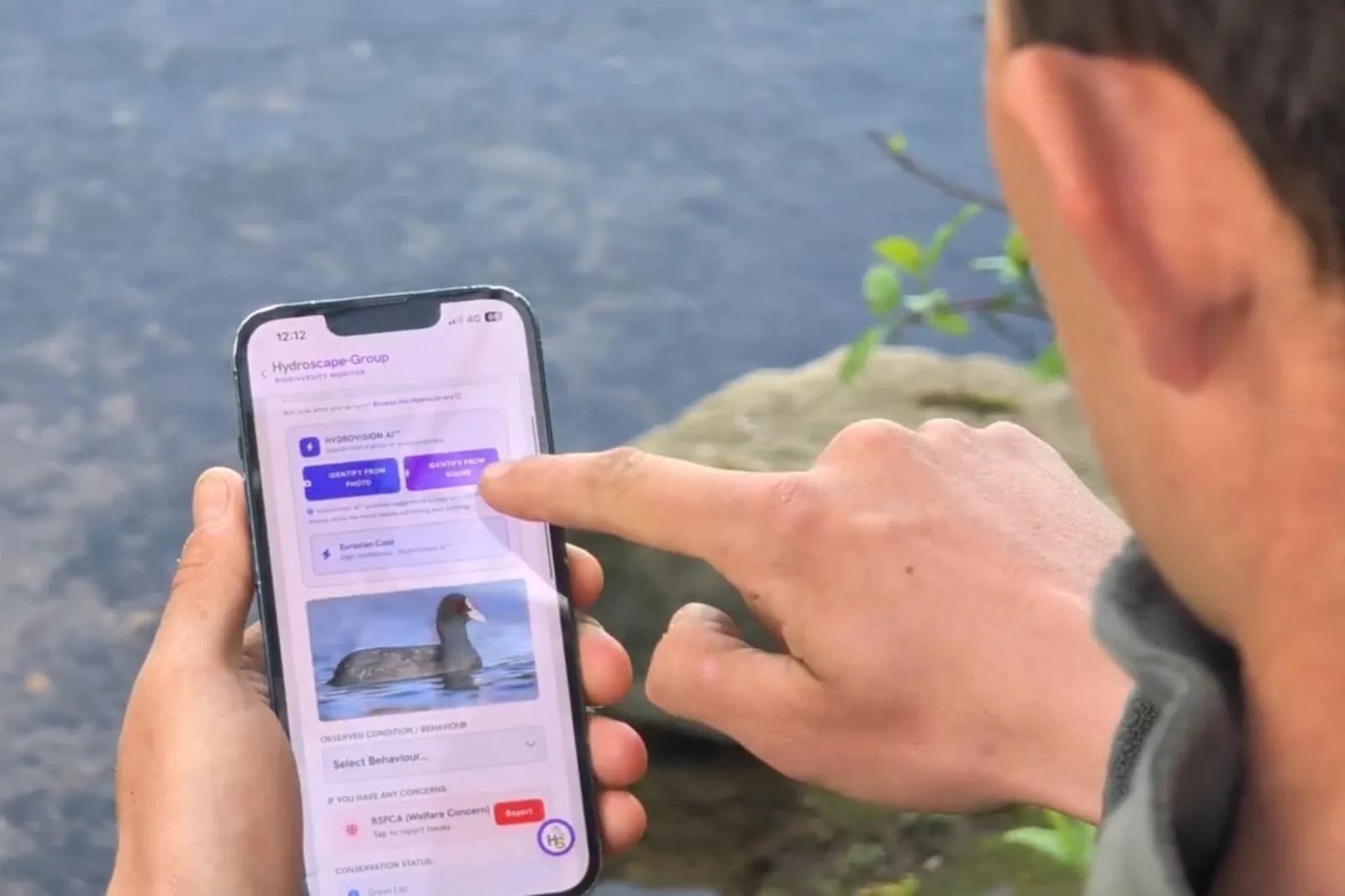
On your phone, at the bankside: you log what you see. A cormorant. A flock. A roost count. A deterrent deployment. A predation sign. A kill. A dead fish on the margin. GPS-stamped, time-stamped, photo-verified by AI. Thirty seconds per record. No account required for the public reporting forms; a free MyHydroscape account gives you a personal dashboard, a record of your contributions, and exportable reports.
Inside the platform there's a dedicated cormorant module, HydroDeter, built around what an A06 application actually needs. Sightings, roost surveys, non-lethal deterrents tried, behaviour observed. The data feeds an A06 Master Builder that formats submissions to Natural England's five published tests so a club doesn't lose a year-long application cycle to a paperwork failure.
Around that sits the wider platform: the species library, the records of everything else on your water, the dashboards your club can adopt if it wants the same picture for fish, invertebrates, mammals, and plants. The cormorant case is the entry point. The wider record is what makes it credible.
We're UK-built and the records logged so far are heavily UK-weighted, but the platform's global. The HydroLibrary holds reference cards covering more than 1,000 species, in 22 languages.
Who gets to see your data matters, and anglers are right to ask. Your records sit in your MyHydroscape account, owned by you. Aggregate data is what feeds the public dashboard and the regulator-grade evidence packs. Individual records aren't shared without the owner's consent. UK-hosted, GDPR compliant, audit-logged. Independent OWASP audit: 9.9 out of 10.
Where we are
The platform is live and being used on UK waters right now. Over ten thousand biodiversity submissions have been logged. Several dozen UK angling clubs and fisheries are using the platform. Initial meetings have been held with Natural England and the Environment Agency. The Hydroscape App is live on Google Play. The cormorant funnel, from sighting submission, to non-lethal deterrent logging, to A06 evidence pack generation, to direct paperwork support, is end to end free for fisheries.
The broader point
The cormorant question is the sharpest example of a much bigger problem with how freshwater decisions get made in this country.
When a river fails its Water Framework Directive classification, the data driving the decision is almost entirely chemistry. When a habitat designation gets reviewed, the consultancy doing the survey usually has a fortnight on a site that's been there a thousand years. When a regulator looks at a question about a piece of water, they're working from a fragmented patchwork: a bird-recording dataset here, an invertebrate baseline there, a chemical monitoring report from somewhere else, all collected on different timescales by different organisations with different objectives.
What's missing is the stuff every angler knows. Presence of a species, year by year. Relative abundance through a season. Behaviour during weather events. Where the sticky pegs are, and why. The continuous, granular, place-specific knowledge that comes from being on a piece of water for a hundred sessions a year over a decade.
This isn't a technology problem. The fish haven't been hiding. The anglers haven't been refusing to share. The systems built to capture this kind of knowledge just haven't existed at the right shape for the right people.
Existing schemes are clunky. iRecord is built for naturalists and prioritises rare species, brilliant for orchids, less useful for the everyday-but-pressured cormorant question. Riverfly volunteers have built world-class invertebrate baselines but cover one taxon. The water company sewage maps are public-facing and useful for outrage, less useful for evidence.
That's the gap.
What we're aiming at
The goal, and this is the honest version rather than the investor version, is to make angler observation count as evidence. Not as anecdote, not as background colour, but as the structured, verified, regulator-grade record that decisions get made on.
For cormorants specifically, that means two things. It means individual clubs having the evidence base for an A06 application that doesn't get refused on paperwork. And it means the aggregate national picture, what cormorant populations are actually doing on inland waters at scale year on year, existing as a verifiable dataset rather than a series of sealed regional debates.
Beyond cormorants, it's the same logic applied to every decision that touches UK freshwaters. Abstraction reviews. BNG baselines. Habitat designations. Water company enforcement. The catchment plans that get approved and the ones that don't. All of these decisions get made on evidence; the question is whether the evidence includes the stuff anglers and fishery managers have been quietly accumulating for decades.
They exist now.
What we'd ask of you
Two things. One easy, one that takes a conversation.
The easy one. Create a MyHydroscape account. It's free, it takes about two minutes, and it lets you start recording what you see. Cormorants if cormorants are your thing. Otters, kingfishers, pollution events, fish kills, water quality on the canal you fish every Tuesday. The records you log build the dataset that A06 applications, BNG baselines and policy submissions ultimately draw from. Your contributions are your own, exportable, and audit-logged.
The conversation. If your club or syndicate hasn't adopted a biodiversity platform, raise it at the next committee meeting. The cormorant funnel is end-to-end free for fisheries. Wider club adoption (multi-water dashboards, A06 paperwork support, member onboarding) is priced for clubs and scaled to the size and nature of the water. Our cormorant options are all entirely free end to end for everyone. We do platform demonstrations on request: thirty minutes, walking through your specific water, the cormorant questions you're wrestling with, and what the platform would do for them.
We don't charge individual anglers. Club adoption is priced for clubs, scaled to the size and nature of the operation. The conversation is worth having even if you decide it's not for your club this year.
One last thing
The reason we built this, and the reason we keep building it, is a conviction that anglers and fishery managers know things about UK freshwaters that the system has not yet found a way to listen to. That's not a sentimental point. It's been a structural problem with measurable consequences.
On cormorants, that's cost clubs licence applications that should have been granted. It's cost waters years of stock loss while the paperwork was being assembled. It's cost regulators the chance to set thresholds based on the best available evidence rather than the most easily collected.
That changes the moment you start writing it down. Not all at once. But properly. A club with two seasons of structured, verified records on cormorant behaviour has a different conversation with Natural England than a club with a shoebox of scarer receipts. A river basin with five years of citizen-led biodiversity recording has a different conversation with the Environment Agency than one without.
The platform's live. It's working. It's getting better every month. The single biggest thing that determines whether it changes the conversation on UK freshwaters is the number of people who decide to start writing things down.
So start writing things down.
The Hydroscape Team
Two ways to start.
One easy, one that takes a conversation. Pick whichever fits where you are.
Hydroscape is a freshwater biodiversity monitoring platform built by passionate fishery managers with decades of hands-on experience in water management, biodiversity, habitat improvement, and freshwater ecology. Individual reporting forms are free, no account required.
hydroscape-group.co.uk · info@hydroscape-group.co.uk