The rescue and coastal relocation of common seals (harbour seals)
from the River Nene, Peterborough
2022 – 2025
Including a practical template for angling clubs and fisheries facing protected predator conflicts in freshwater environments
Produced by
PETERBOROUGH & DISTRICT ANGLING ASSOCIATION
Established 1875
Published by Hydroscape-Group Ltd
Delivered by P&DAA volunteers working with the Environment Agency, Natural England,
RSPCA East Winch, International Zoo Veterinary Group, Marine and Wildlife Rescue,
Genuswave (Targeted Acoustic Startle Technology), and the Angling Trust.
Contents
- Foreword
- PART ONE , The River Nene Story
- 1. Executive Summary
- 2. Background and Context
- 3. Identification of the Problem
- 4. The Campaign
- 5. Acoustic Deterrent Technology: Genuswave TAST
- 6. Key Milestones and Timeline
- 7. Legal and Regulatory Framework
- 8. The Capture and Relocation Operation
- 9. Outcomes and Impact
- 10. Supporting Quotes
- PART TWO , Your Guide to Action
- 11. Template: Step-by-Step Guide
- 12. Key Contacts and Resources
- 13. Lessons Learned
- 14. The Wider Debate: Seal Management Perspectives
- 15. Conclusion
- 16. References and Sources
- Glossary of Key Terms
- Appendices
When the first reports came in of seals living in the River Nene, I don’t think any of us imagined where the next three years would take us. P&DAA is a volunteer-run angling association. We are not wildlife managers, not lobbyists, not campaign strategists. But when nobody else was going to fix this, we decided we would.
What followed was the hardest thing P&DAA has ever done. Hundreds of hours of phone calls, emails, meetings, and evidence gathering. Building a coalition of 25 clubs. Engaging contractors and specialists we had never heard of. Navigating licensing processes designed for government agencies, not volunteers. And doing all of this while watching the fish stocks we had spent decades building disappear before our eyes.
This was an ecological disaster. Not a fishing problem – an ecological disaster. The Environment Agency’s own data showed a river stripped of life across 25 kilometres. Fish, birds, mammals, invertebrates – the entire food chain was collapsing. And yet the organisations best placed to fix it did not act. The agencies with the expertise, the budgets, and the statutory responsibilities watched it happen. It fell to a group of volunteers to do what should never have been our job.
We never wanted to harm the seals. From day one, our position was clear: these are marine animals that do not belong in freshwater. Their welfare was compromised, the river’s ecology was being destroyed, and the situation was getting worse every month. We offered to pay for the rescue ourselves. We just needed the system to let us do the right thing. But doing the right thing is not always easy. Seals are popular with the public. The perception that removing them is somehow cruel had to be overcome with evidence, patience, and honesty. Wider ecology and common sense must outweigh difficult public perception issues. We need to stand by what’s right, not what’s easy.
This case study exists so that nobody else has to start from scratch. Everything we learned – the contacts, the costs, the technology, the licensing process, the mistakes – is in these pages. If you are reading this because seals have arrived in your river, take heart: it can be done. The journey is long, but the destination is worth it.
The job now is recovery. It will take decades and hundreds of thousands of pounds to rebuild what was lost in three years. But the Nene is resilient, and so is P&DAA. We started this because we are custodians of our water. We will finish it for the same reason.
Rob Harris
Chairman, Peterborough & District Angling Association
2025
The River Nene Story
What happened, why it mattered, and how P&DAA resolved it
1. Executive Summary
KEY FACTS AT A GLANCE
Location: River Nene, Peterborough
Species: Common seal (Phoca vitulina)
Number of seals: 5 (Daffodil, Trifle, Hellebore, Primrose, Pumpkin Pie)
Distance inland: ~40 miles from the coast
Duration: Dec 2022 – Oct 2025 (~3 years)
Fish stock decline: ~95% of adult fish
Estimated fish consumed: ~500,000
Clubs in coalition: 25 across 3 counties
Outcome: All seals safely relocated to coast
Lead organisation: P&DAA (volunteer-led)
This case study documents the complete process by which Peterborough & District Angling Association (P&DAA), a volunteer-run angling club founded in 1875, identified, campaigned against, and ultimately resolved the issue of rehabilitated common seals becoming resident in the freshwater River Nene in Peterborough.
Over approximately three years, from December 2022 to October 2025, P&DAA volunteers led every stage: gathering evidence, building a coalition of 25 clubs across three counties, engaging contractors and specialist businesses, sourcing and deploying Genuswave Targeted Acoustic Startle Technology (TAST) devices, coordinating the capture operation with the International Zoo Veterinary Group and Marine and Wildlife Rescue, and securing the safe coastal relocation of all five resident common seals.
The Angling Trust played an important supporting role in the earlier phase, specifically in writing to the RSPCA to request the suspension of seal releases at Sutton Bridge and helping to change that release practice. However, the practical work of engaging contractors, sourcing acoustic deterrent technology, coordinating the rescue operation, and managing multi-agency relationships on the ground was driven and delivered by P&DAA volunteers throughout.
This document is intended as a practical template for any angling club, fishery, or environmental organisation facing a similar situation with seals or other protected predators in freshwater systems.
1.1 Methodology and Sources
This case study was compiled using publicly available sources and primary documents. These include the Environment Agency’s River Nene Fisheries Survey Summary (February 2025, LNA A&R Team), providing complete sonar fish stock data across six survey locations. A veterinary method statement for the seal translocation operation was also consulted, detailing capture approaches, sedation risks, and welfare protocols.
Key scientific evidence comes from the peer-reviewed paper by Götz and Janik (2016, Animal Conservation, DOI: 10.1111/acv.12248), documenting long-term TAST effectiveness on a Scottish fish farm. Additional sources include P&DAA official communications, Angling Trust press releases, media coverage from Peterborough Today, ITV News Anglia, BBC, and The Telegraph, official RSPCA statements, Natural England licensing guidance, and further TAST research published in Fisheries Research (Walmsley et al., 2025).
All quotes are attributed to their published source with date. Limitations include the absence of independently audited cost data and the fact that some EA survey years show gaps where specific sections were not surveyed.
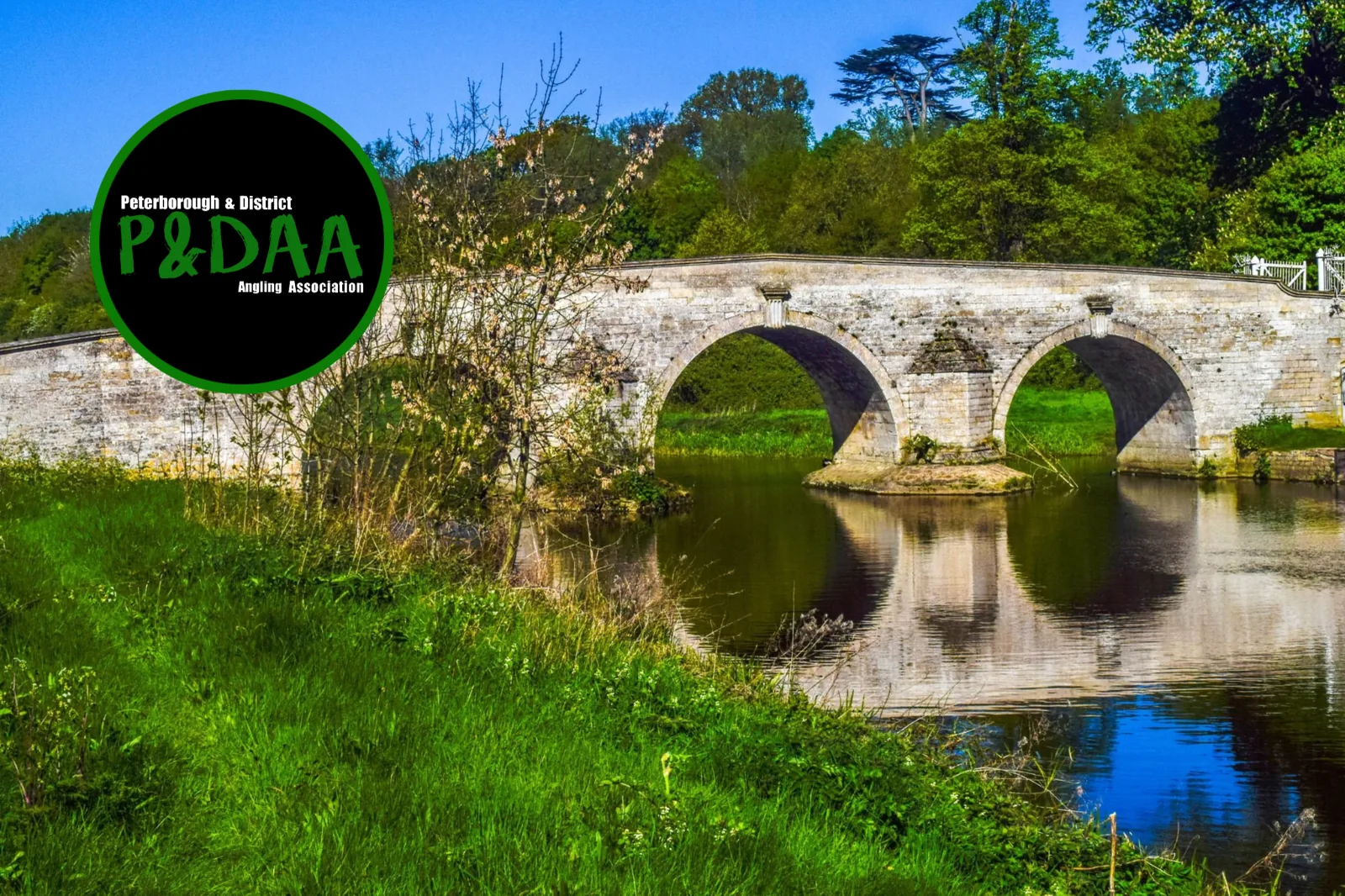
The River Nene at Peterborough, the water at the heart of the case study, and the home stretch of the Peterborough & District Angling Association.
2. Background and Context
2.1 About P&DAA
The Peterborough & District Angling Association was founded in 1875 and controls approximately 12 miles of the River Nene and stretches of the River Welland from Crowland and through Spalding Town. The club has around 2,000 members. During the seal crisis, P&DAA reduced its annual membership from £30 to £15 as a gesture to members whose fishing had been severely affected – a decision that cost the club approximately £15,000 per year in lost revenue at a time when its expenditure was higher than ever.
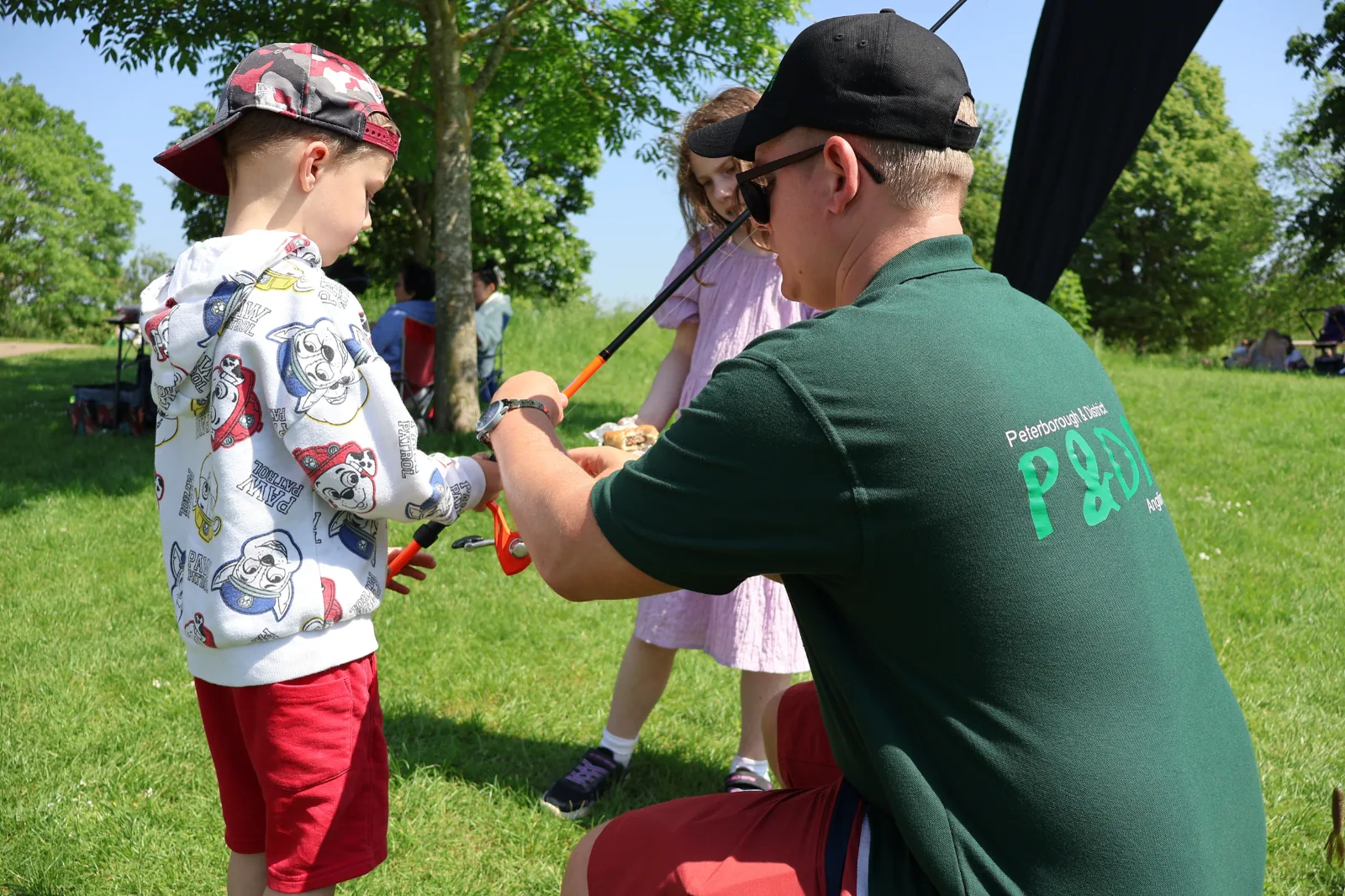
P&DAA members at Ferry Meadows, the fishery community whose evidence drove the case study.
2.2 The River Nene
The River Nene rises in Northamptonshire and flows approximately 100 miles northeast through Peterborough to The Wash. Through Peterborough it passes the city centre at Town Bridge, the rowing course at Thorpe Meadows, Ferry Meadows Country Park, and numerous backwater stretches. The river supports diverse coarse fish populations including barbel (specimens exceeding 18lb), chub (over 7lb), bream (double figures), pike, perch, roach, carp, tench, and zander.
The Nene is already under significant environmental pressure from agricultural pollution, sewage discharge, water abstraction, and climate change – making the ecosystem particularly vulnerable to additional predation pressure.
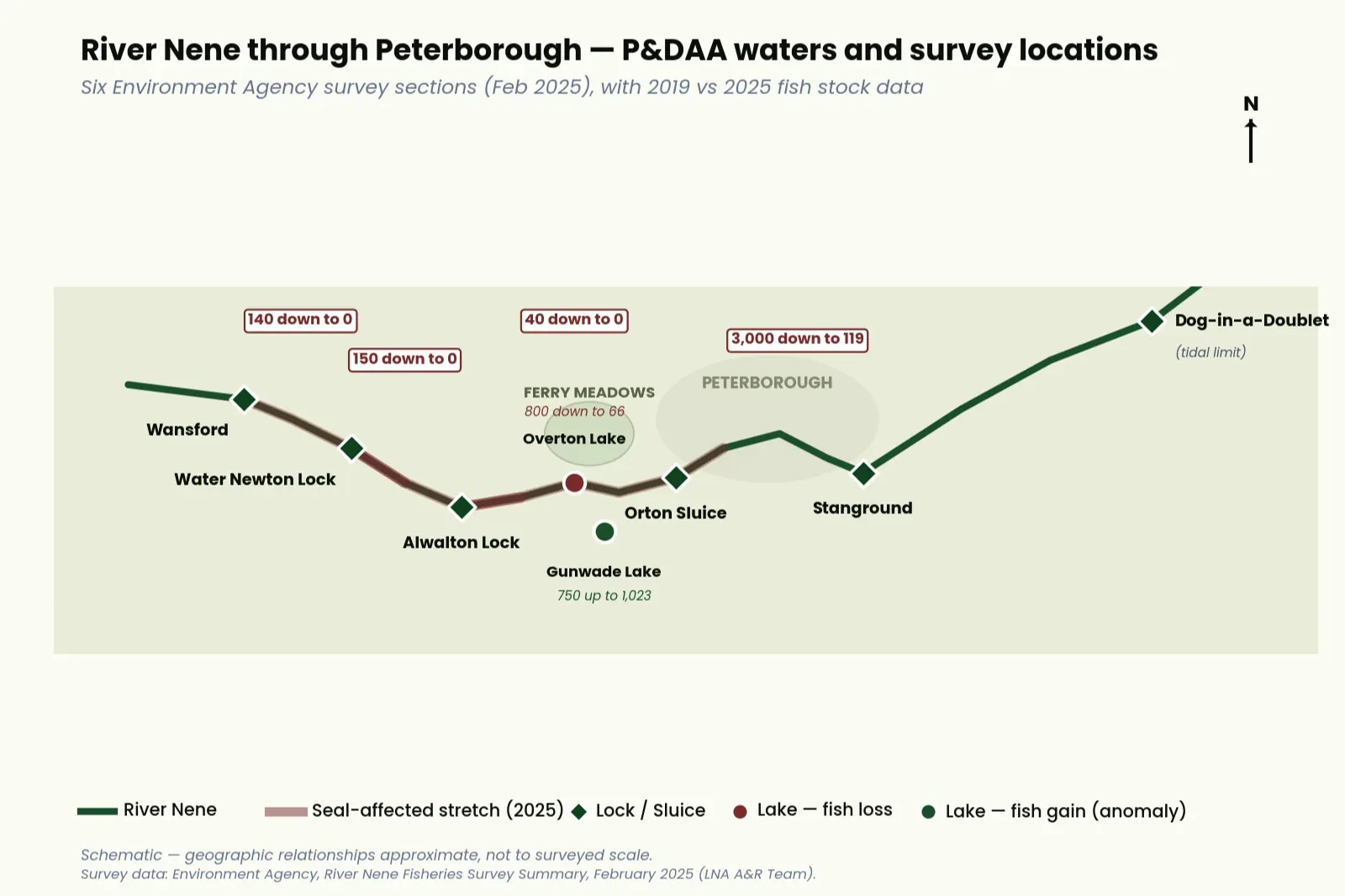
The River Nene through Peterborough, showing P&DAA stretches, lock structure, and the spread of seal sightings 2022–2025. Illustrative orientation aid, not survey-grade cartography.
2.3 Seals and Freshwater: The Natural Baseline
Seals have occasionally navigated the Nene for decades. This is normal: a seal may travel upstream for a week or two before returning to the coast. The situation in Peterborough was fundamentally different. Rehabilitated common seals released by the RSPCA at Sutton Bridge (approximately four miles inland from The Wash) were travelling upstream instead of downstream, establishing long-term residency around Peterborough – some 40 miles from the coast. At least two had been present for over 13 months by early 2024, and all were identified as tagged rescue seals from RSPCA East Winch.
2.4 RSPCA East Winch Wildlife Centre
The RSPCA East Winch Wildlife Centre in Norfolk was established following the 1988 Phocine Distemper Virus outbreak (approximately 23,000 harbour seals lost across Europe). The centre opened in 1993 and has purpose-built seal pools and veterinary facilities. It had historically released all rehabilitated seals at Sutton Bridge, expecting them to follow the outgoing tide into The Wash. The problem: a proportion were turning upstream – disoriented, unfamiliar with their colonies, and unperturbed by proximity to people after extended time in care.
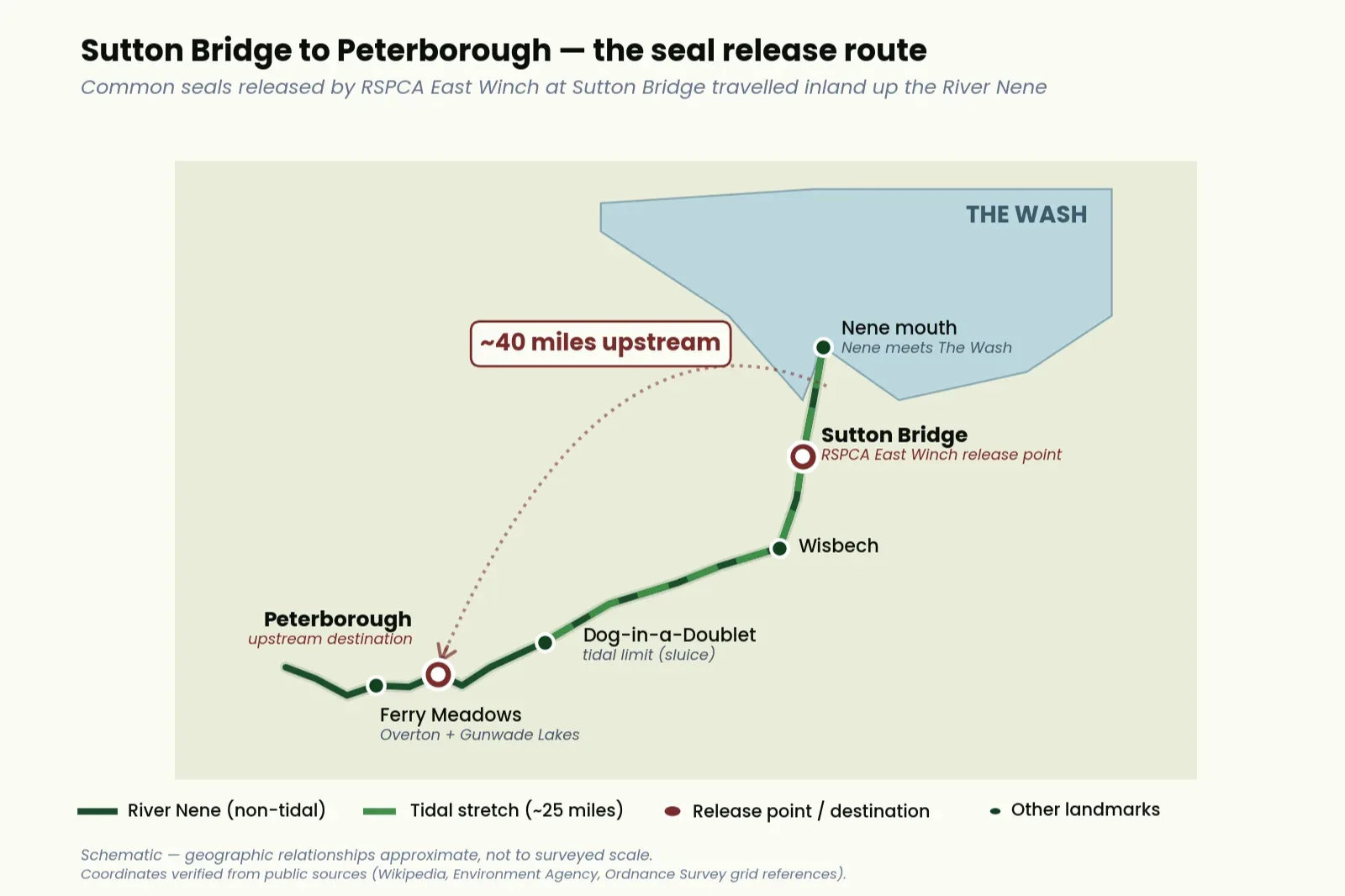
Sutton Bridge to Peterborough, the geography that turned a coastal release into a freshwater problem. Illustrative orientation aid, not survey-grade cartography.
3. Identification of the Problem
3.1 First Sightings and Early Evidence
Common seals residing in the Nene for extended periods were first identified in December 2022. P&DAA members recognised early that these were not transient visitors. Volunteers confirmed locations at Orton Downstream, Ferry Meadows, Stibbington, and upstream to Bluebell Lakes – and identified them as tagged animals from RSPCA rehabilitation.
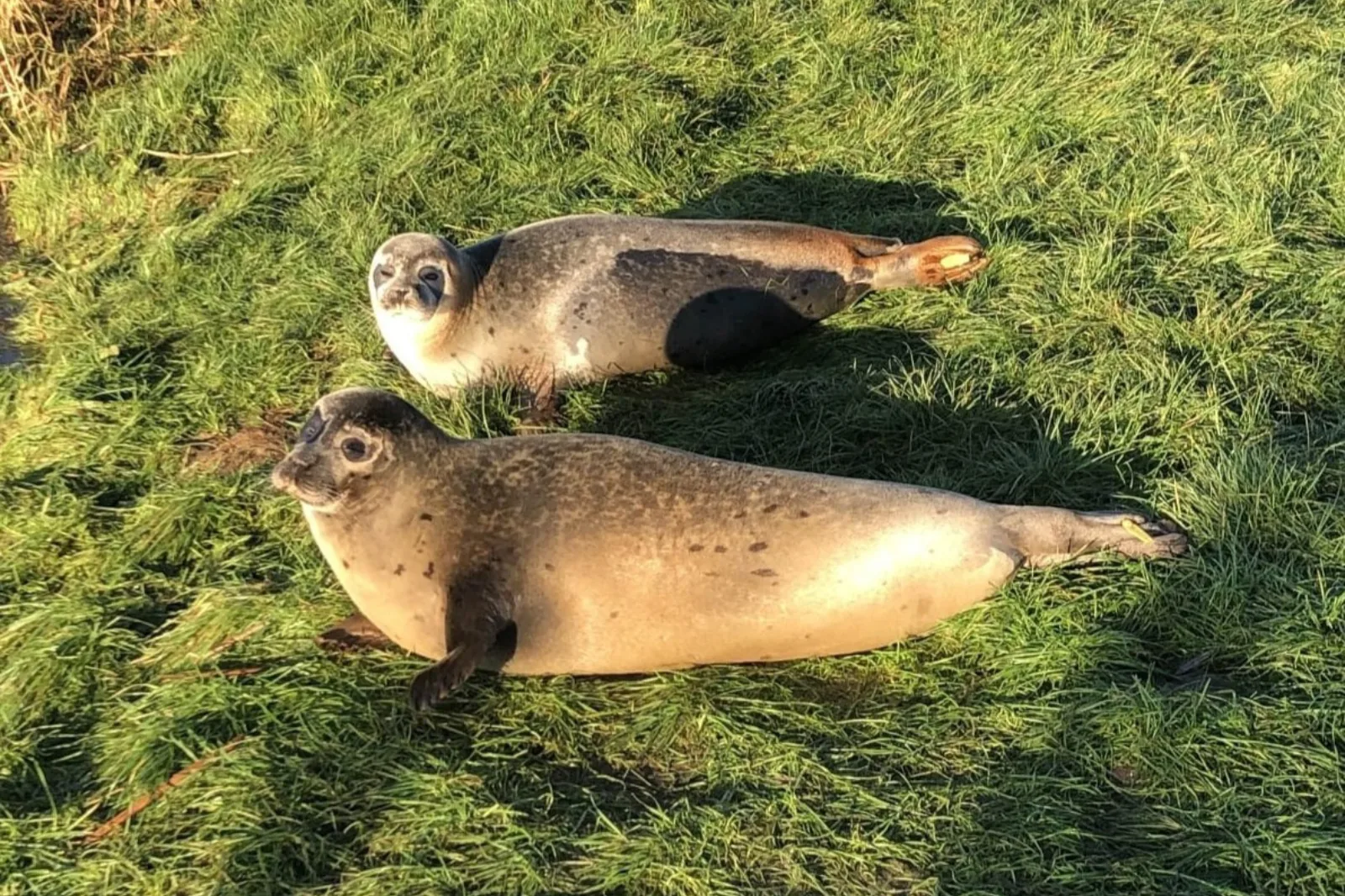
Two tagged common seals hauled out beside the River Nene, the visible link between sighting on the water and release record at the wildlife centre.
3.2 Establishing the Link to RSPCA Releases
P&DAA established that the resident seals were tagged rescue animals released from East Winch at Sutton Bridge. Over the course of the campaign, five individual common seals were identified and tracked: Daffodil, Trifle, Hellebore, Primrose, and Pumpkin Pie. The club published its ‘Tackling the Seals’ statement and deployed a seal sighting reporting system (Google Form, later integrated into the P&DAA app) for confidential public reporting.
3.3 Environmental Impact Assessment
An adult common seal consumes an average of 3–5kg of fish per day. NOAA estimates seals eat 4–6% of their body weight daily; an adult female common seal weighing around 80–100kg would need approximately 4–5kg. Five common seals became resident in the Nene over the three-year period: Daffodil, Trifle, Hellebore, Primrose, and Pumpkin Pie – all originally rescued as pups, rehabilitated at East Winch, and released at Sutton Bridge. They had made their way over 40 miles inland through locks and gates built for narrowboats. Pumpkin Pie was last seen upstream of P&DAA’s sections in 2023 and never returned. Hellebore and Primrose disappeared from the river around July 2025, roughly a month before the capture operation began. Daffodil and Trifle – the final two – were captured and safely relocated to the coast.
By April 2024, P&DAA Chairman Rob Harris estimated the resident seals could have consumed approximately 500,000 fish – five times more than were lost in the Goldie Meadows pollution disaster of December 2023. As Harris told the BBC, adult fish stocks in the Nene had fallen by roughly 95%. The Environment Agency conducted sonar surveys confirming that large sections of the river contained no fish at all.
The EA survey noted: the Nene has limited to no longitudinal passage for coarse fish species. It is effectively a river split into sections via locks. There is nowhere for larger fish to escape high-level predation. The river had also been historically straightened, leaving fish with no habitat to hide in.
Figure 1: Environment Agency Sonar Fish Survey Data (Feb 2025)
The following table presents the complete dataset from the Environment Agency’s sonar fish stock survey of the River Nene, February 2025, compared to previous survey years. Data measures estimated numbers of larger adult fish (bream, roach, barbel, pike, carp, tench, zander).
| Location | 2019 | 2021 | 2023 | 2024 | 2025 | Seals ’25 |
|---|---|---|---|---|---|---|
| Peterborough city centre | 3,000 | 3,000 | 1,000 | 500 | 119 | No* |
| Orton Sluice to Alwalton Lock | 40 | — | — | — | 0 | Yes |
| Alwalton Lock to Water Newton Lock | 150 | 150 | — | — | 0 | Yes |
| Water Newton Lock to Wansford Lock | 140 | 0† | — | — | 0 | Yes |
| Overton Lake, Ferry Meadows | 800 | — | — | — | 66 | Yes |
| Gunwade Lake, Ferry Meadows | 750 | — | — | — | 1,023 | Yes |
— = not surveyed. * Seals had moved upstream by Feb 2025. † New marina opened in section.
Source: Environment Agency, River Nene Fisheries Survey Summary, February 2025, LNA A&R Team.
The EA’s summary stated that the 25km stretch from Wansford Lock to the tidal limit at the Dog in a Doublet was almost devoid of fish in open water. The impact on the wider ecology for mammals, birds, and invertebrates would be wide-ranging and large-scale. Areas including Thorpe Meadows Marina, Riverside Mead, Ferry Meadows, Stibbington moorings, and Alwalton moorings – which were full of roach and pike in previous surveys – were empty when surveyed in winter 2025.
The EA warned that long-term seal predation will put critical pressure on all species present, not just the fish. The river would have been downgraded for its Water Framework Directive classification (the Government’s standard for measuring river health), with recovery expected to take decades.
The Gunwade Lake anomaly is notable: fish numbers increased from 750 to 1,023 because fish from nearby Overton Lake (which dropped from 800 to just 66) had migrated to Gunwade. This is because Gunwade is further from the river and provides conditions unfavourable for seals to haul out and rest.
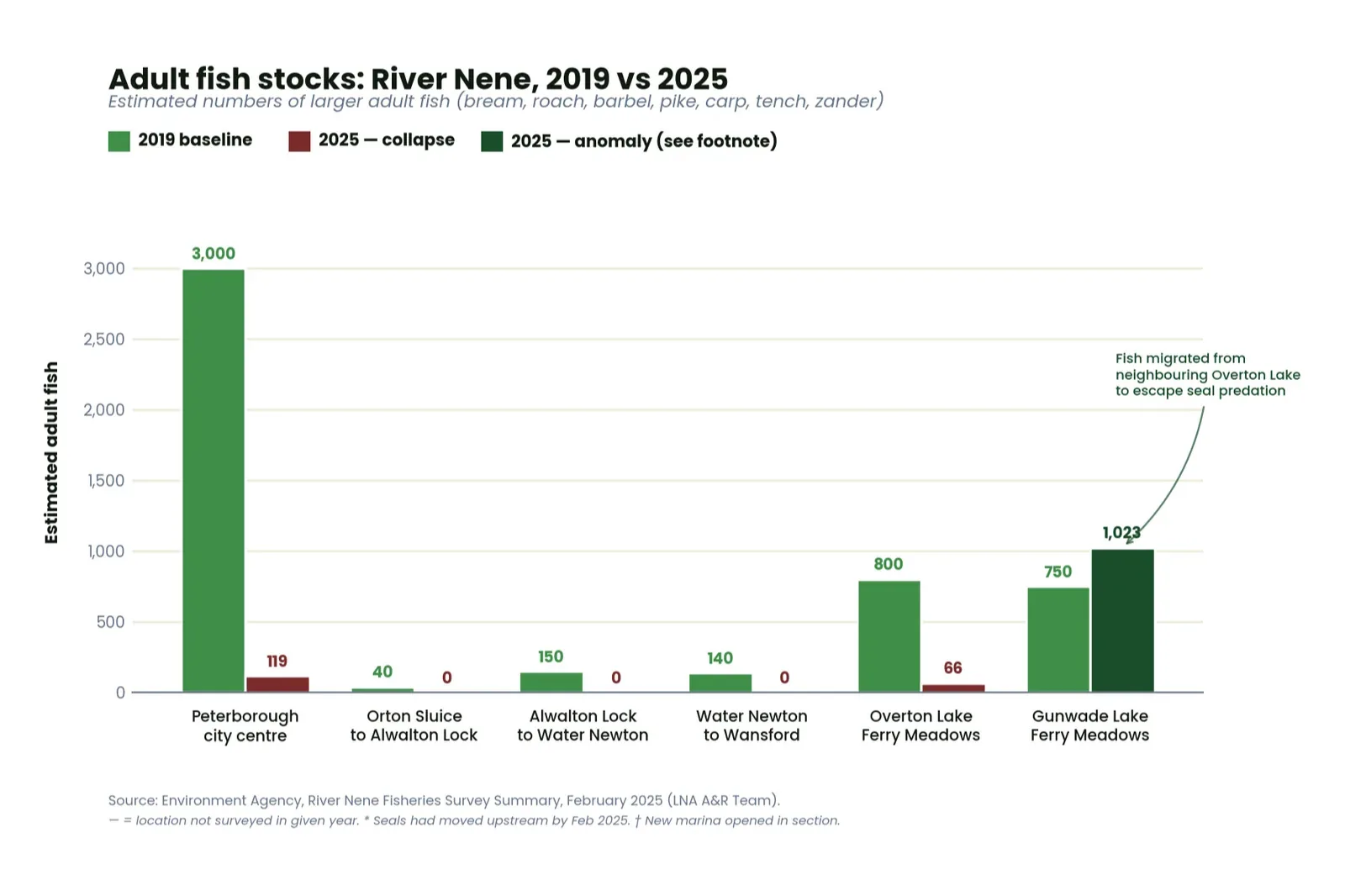
Adult fish stocks on the River Nene, 2019 against 2025, the EA survey data presented in Figure 1, visualised. The Gunwade Lake anomaly reflects fish displaced from neighbouring Overton Lake.
3.4 Human Safety Concerns
As fish stocks deteriorated, the seals became increasingly hungry and moved into areas with high public footfall. In an urban environment like Peterborough – parks, leisure areas, rowing courses, and the city centre – maintaining safe distances was extremely difficult. Members of the public were approaching for selfies and attempting to feed the animals. The veterinary method statement for the capture operation noted that two of the seals showed no reaction to people passing within 1.5 metres.
Common seals can deliver a serious bite. Seal bites carry a risk of ‘seal finger’ – a bacterial infection caused by Mycoplasma species found in seal mouths, which can cause severe swelling, joint damage, and requires specific antibiotic treatment. The RSPCA, BDMLR, and Marine and Wildlife Rescue all advise a minimum distance of at least 10 metres. Dogs are also at significant risk: a startled or territorial seal can injure or kill a dog, and dog bites to seals are equally dangerous. The combination of habituated seals and unsupervised public access created a serious and growing safety concern.
4. The Campaign
4.1 P&DAA’s Strategic Approach
P&DAA was explicit from the outset: no lethal action. The club’s position was that these marine animals did not belong in freshwater, their welfare was compromised, and they should be safely returned to the coast. The club offered to pay for relocation. By framing the campaign around seal welfare as well as ecological welfare, P&DAA avoided antagonism and built constructive relationships with every agency involved.
4.2 Evidence Gathering
Volunteers invested hundreds of hours: documenting sightings, photographing tagged seals, recording behaviour patterns, cataloguing catch changes, and liaising with the EA. The club’s app and sighting form enabled confidential public reporting, building a comprehensive evidence base that could not be dismissed.
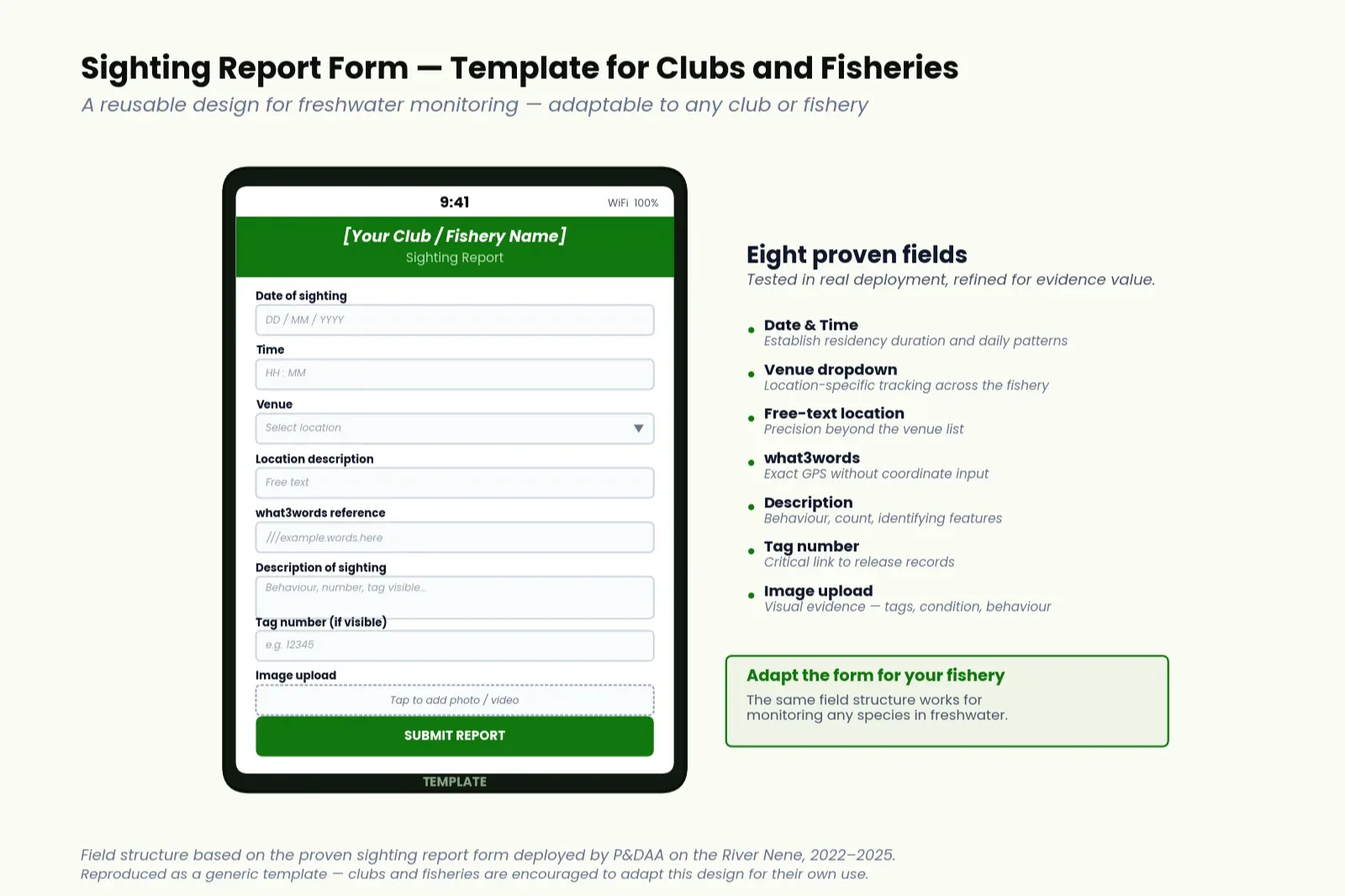
Sighting report form, a reusable template based on the design deployed by P&DAA. The same field structure works for monitoring any species in freshwater.
4.3 Building a Regional Coalition
P&DAA built a coalition of 25 clubs across Cambridgeshire, Lincolnshire, and Norfolk. This demonstrated a regional – not parochial – problem and carried greater weight with decision-makers.
4.4 Changing RSPCA Release Practices
The Angling Trust wrote formally to the RSPCA CEO on 28 March 2024, citing P&DAA evidence. By 30 April 2024, the RSPCA announced a temporary suspension of Sutton Bridge releases. P&DAA welcomed this but called for permanent change. Seals in England are protected under UK law and the process of changing established release practices required sustained, evidence-based engagement.
4.5 Multi-Agency Engagement – Led by P&DAA
P&DAA directly engaged the RSPCA, Environment Agency, Natural England, and specialist contractors. Volunteers spent hundreds of hours on calls, emails, and meetings. Identifying, engaging, and coordinating contractors and technology providers was undertaken entirely by P&DAA.
5. Acoustic Deterrent Technology: Genuswave TAST
5.1 What is TAST?
P&DAA sourced and deployed Genuswave Targeted Acoustic Startle Technology (TAST) – developed by GenusWave with the University of St Andrews’ Sea Mammal Research Unit. In simple terms, TAST makes a short, sharp underwater sound that triggers the seal’s natural ‘startle’ reflex – an involuntary flinch response hardwired into the brainstem, similar to how you jump at a sudden loud noise. This causes immediate flight behaviour.
What makes TAST different from older deterrent devices is that seals do not get used to it. With conventional Acoustic Deterrent Devices (ADDs), seals learn to ignore the noise and even associate it with food – essentially treating it as a dinner bell. With TAST, the opposite happens: repeated exposure makes seals more cautious, not less. Scientists call this ‘sensitisation.’
The peer-reviewed research underpinning TAST is substantial. In a 19-month long-term trial on a Scottish salmon farm, Götz and Janik (2016, Animal Conservation) demonstrated a 91% reduction in fish lost to seal predation within the test site and a 97% reduction when compared against control sites. Predation was completely absent in 10 of the 12.5 months during which the system was operational. Harbour porpoise and otter distribution around the farm was not affected by the TAST signal, confirming that the technology only deters the target species.
5.2 TAST vs. Conventional ADDs
TAST emits brief signals (~400 milliseconds) at a 1–2% duty cycle, versus 50–100% for conventional devices. It operates in a frequency band where seals hear better than dolphins and porpoises, allowing species-specific deterrence. Effective range is 50–80 metres, with no effect beyond approximately 250 metres.
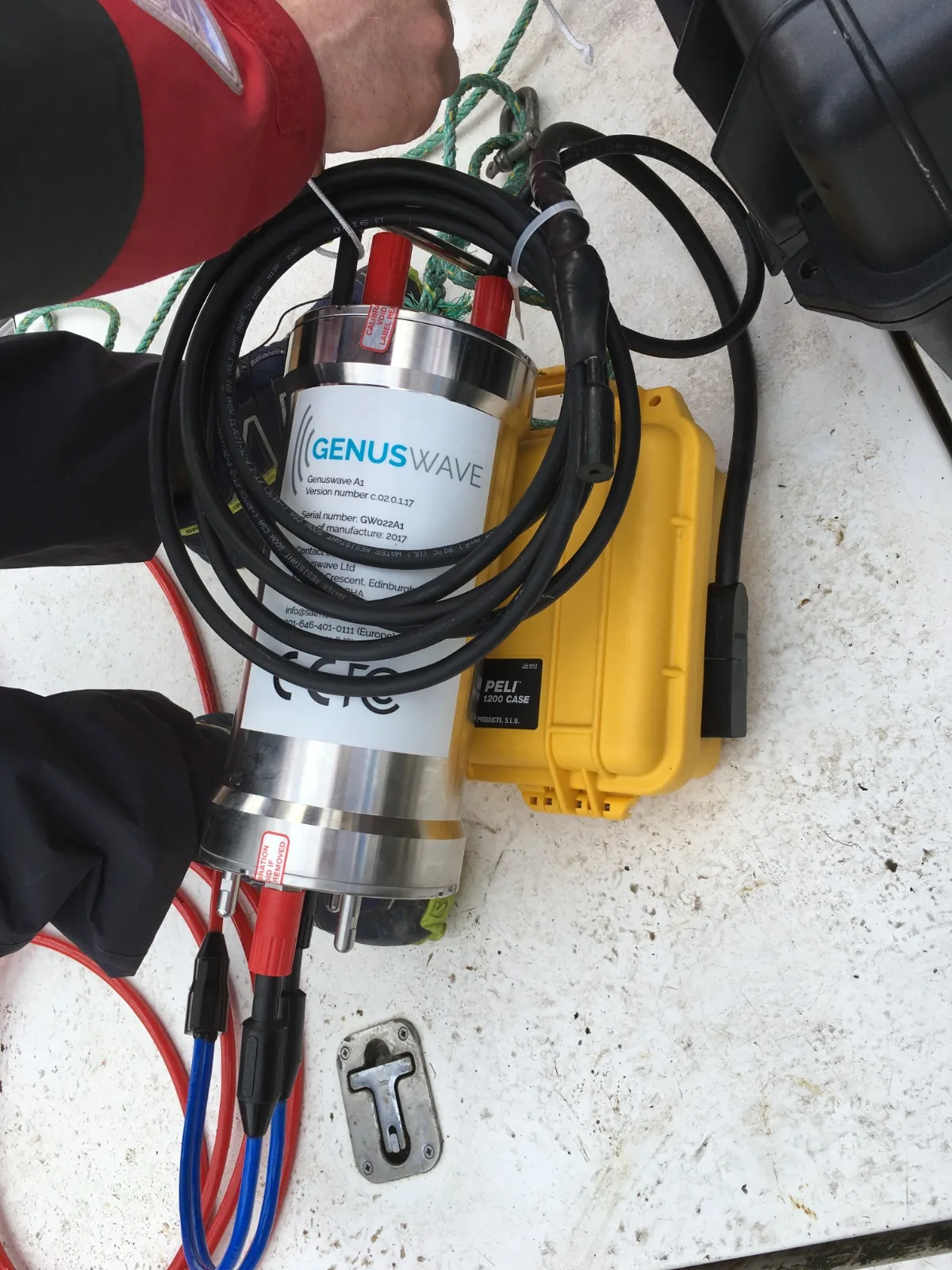
A Genuswave A1 unit being prepared for deployment, alongside its Peli 1200 transit case. The technology that re-opened the freshwater intervention question: short, sharp non-impulsive signals that trigger the seal's startle reflex without habituation.Photograph: Suzannah Walmsley
| Specification | Detail |
|---|---|
| Technology | Targeted Acoustic Startle Technology (TAST) |
| Manufacturer | GenusWave (with University of St Andrews) |
| How it works | Triggers the seal’s involuntary startle reflex – a brainstem response causing immediate flight |
| Signal duration | ~400 milliseconds per signal |
| Duty cycle | 1–2% (vs. 50–100% for conventional ADDs) |
| Effective range | 50–80 m (no effect beyond ~250 m) |
| Habituation | None – seals sensitise (increasing avoidance over time) |
| Non-target species | Species-specific frequency band; safe for dolphins / porpoises / otters |
| Proven effectiveness | Up to 97% reduction in seal predation (tested on grey seals); 90%+ in aquaculture |
| Accreditation | ASC (Aquaculture Stewardship Council) approved; peer-reviewed |
| Website | genuswave.com |
5.3 Deployment on the River Nene
P&DAA deployed TAST to discourage seals from key locations. A protocol negotiated with Natural England and the EA established that acoustic deterrents could be used in freshwater without a separate licence – a nationally significant precedent now available to any club in England.
| 6. Key Milestones and Timeline | Date |
|---|---|
| Event | Dec 2022 |
| First reports of common seals residing in the River Nene. P&DAA begins monitoring. | Nov 2022 – |
| Tagged common seals identified as RSPCA East Winch releases. Five eventually tracked: Daffodil, Trifle, Hellebore, Primrose, Pumpkin Pie. | 2023 |
| Hundreds of volunteer hours on evidence gathering. Pumpkin Pie last seen upstream of P&DAA sections; never returned. | Dec 2023 |
| Goldie Meadows pollution disaster kills 100,000+ fish. Seal predation loss estimated at five times greater. | Jan 2024 |
| P&DAA publishes ‘Tackling the Seals’. Announces meetings with authorities. Invites clubs to coalition. | Jan 2024 |
| Angling Trust writes formally to RSPCA CEO requesting cessation of Sutton Bridge releases, citing P&DAA evidence. | 28 Mar 2024 |
| P&DAA Chairman Rob Harris tells the BBC adult fish stocks have fallen by roughly 95%. Estimates 500,000 fish consumed by resident seals. | Apr 2024 |
| RSPCA announces temporary suspension of releases at Sutton Bridge. | May 2024 |
| P&DAA welcomes suspension. Begins engaging contractors for rescue operation. Genuswave TAST sourced and deployed; freshwater acoustic deterrent protocol established as national precedent. | 2024–2025 |
| Environment Agency sonar fish survey confirms ‘dire’ and ‘unprecedented’ decline across all six survey locations. | Feb 2025 |
| P&DAA engages IZVG and Marine and Wildlife Rescue. Natural England licence pursued. | Feb 2025 |
| Natural England licence (Form A17) granted on behalf of P&DAA, authorising the take of up to five common seals by hand net in a defined upstream stretch of the Nene; valid 6 months. | 3 Jun 2025 |
| Hellebore and Primrose disappear from the river ahead of operations. | Jul 2025 |
| Daffodil safely netted under IZVG veterinary oversight; transferred to RSPCA East Winch for assessment. | Aug 2025 |
| Daffodil released at Horsey Beach, Norfolk, near her original rescue site. | Sep 2025 |
| Trifle safely netted; transferred to RSPCA East Winch for extended observation. | Sep 2025 |
| Trifle released at the coast. River declared seal-free. | Oct 2025 |
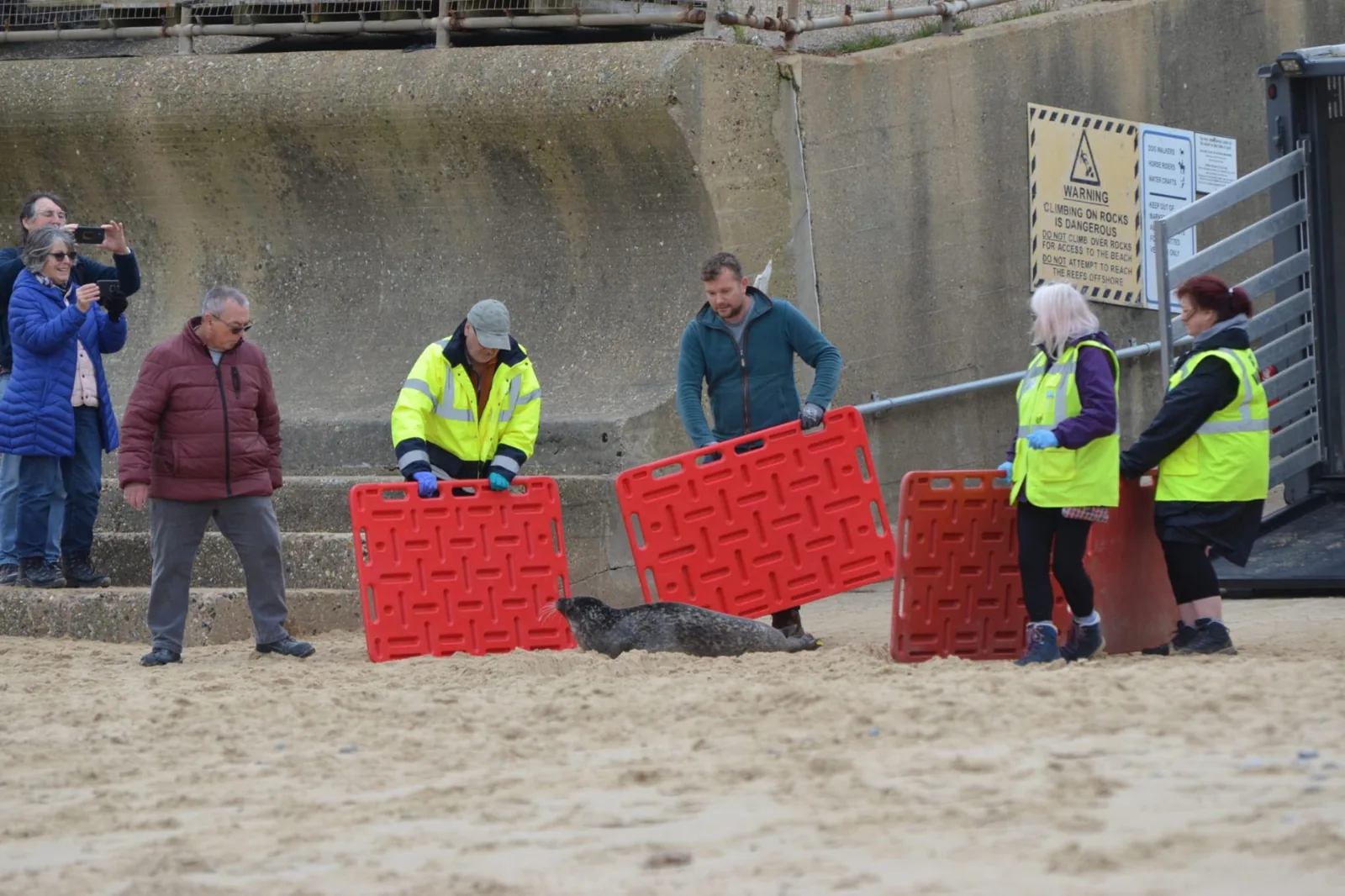
'Daffodil' returns to coastal habitat, September 2025, the release that demonstrated the operational protocol works.Photograph: Jake Davoile, Angling Trust
7. Legal and Regulatory Framework
7.1 Seal Protection Legislation
Common seals (harbour seals) in England are protected under the Conservation of Habitats and Species Regulations 2017. Both common seals (Phoca vitulina) and grey seals (Halichoerus grypus) are European Protected Species. Capture, injury, or disturbance without a Natural England licence is a criminal offence. This was the single greatest barrier to resolution.
7.2 The Licensing Process
Clubs wishing to capture and relocate seals must apply for an individual licence from Natural England using Form A17. Important to note: Natural England issues seal licences to named individuals, not to organisations. A club coordinating a campaign will need to nominate one person to be the licensee of record, supported where appropriate by additional authorised persons (typically the veterinary contractors carrying out the work). The application must demonstrate three things: that there is no satisfactory alternative to capture; that the action would not be detrimental to the conservation status of the species; and that appropriate welfare safeguards are in place. Licences are free of charge and Natural England aims to decide within 30 working days. Any actions taken must be reported on Form LR17 no later than two weeks after the licence expires.
In the P&DAA case, the licensing process stalled multiple times. P&DAA’s persistence in restarting progress through continued correspondence and follow-up was essential. The Natural England licence was finally granted on 3 June 2025, well beyond the 30-working-day target. The licence was issued on behalf of P&DAA to a named individual (with IZVG veterinary staff as additional authorised persons), authorised under section 10(1)(c)(iia) of the Conservation of Seals Act 1970, protection of animal or human health or public safety. It permitted the take of up to five common seals (Phoca vitulina) by hand net only, in a defined upstream stretch of the River Nene, valid for approximately six months. Clubs should expect delays of this scale, narrowing of permitted methods at the licensing stage compared with the application, and maintain detailed records of all communications.
7.3 The Acoustic Deterrent Protocol
A protocol negotiated between P&DAA, Natural England, and the EA established that Genuswave TAST can be used to move seals in freshwater humanely without a separate licence. This is a nationally significant precedent, now available to any club in England facing a similar situation. It is doubly valuable: it allows immediate action while the lengthy A17 licence process runs, and the seal licence itself requires acoustic deterrents to be trialled as a non-lethal alternative before capture is attempted. The TAST protocol therefore satisfies a licence precondition as well as standing alone as an intervention.
7.4 Government Guidance on Release
Government guidance on the release of rehabilitated seals requires animals to be returned near their original rescue site, in conditions that give them the best chance of reintegrating with wild colonies. The GOV.UK guidance on seals makes clear that Natural England is responsible for seal licensing in rivers. Releasing at an inland tidal location, as was historically practised at Sutton Bridge, did not achieve the objective of returning seals to the coast. Notably, at least one neighbouring rehabilitation centre was already using a direct coastal release site. The RSPCA’s decision to suspend Sutton Bridge releases and move to coastal alternatives brought their practice in line with this guidance.
8. The Capture and Relocation Operation
8.1 Planning and Preparation
With the Natural England licence granted on 3 June 2025, the operation moved into its operational phase. P&DAA coordinated the operation: IZVG for veterinary oversight, Marine and Wildlife Rescue for seal handling, Genuswave TAST for tactical management. Years of observation data – haul-out sites, feeding areas, access points – was essential.
A detailed veterinary method statement was prepared for the translocation, assessing each seal location individually. The statement noted that all seals observed were in very good condition, clearly sustaining themselves well in the river, and showing no outward signs of illness or injury. Two individuals resident at the rowing lake were well habituated to humans and dogs, showing no reaction as people passed within 1.5 metres. This extreme habituation underlined both the public safety risk and the welfare concern.
The method statement identified three primary capture approaches. The preferred method was hoop net capture from the bank, which avoids the need for sedation entirely. Where this was not achievable, darting with sedation from a boat or bank was considered – effective but carrying a significant drowning risk if the seal enters the water before drugs take full effect. The third approach was seine netting across narrow river sections to confine the seal. Each location required a different plan based on river width, bank access, haul-out position, and the availability of natural barriers such as weirs and locks to restrict movement.
Important note for clubs templating off this case: the application and the method statement explored three approaches; the licence ultimately permitted only hand-net capture. Natural England narrows permitted methods at the licensing stage. Plan for the most restrictive method to be the only one available on the day, and have the operational expertise to deliver it.
The statement was explicit about the risks: sedation and anaesthesia of marine mammals is never without risk, with drowning being the most significant danger. The method required experienced seal handlers, veterinary support, drone and boat-based monitoring, and transport crates positioned close to capture sites. Marine and Wildlife Rescue, based in Great Yarmouth, provided the specialist handling team alongside staff from a Norfolk aquarium experienced in working with adult seals.
8.2 Capture and Assessment
The final two resident common seals – Daffodil and Trifle – were captured using netting operations under IZVG veterinary oversight. Daffodil was guided into a stretcher and lifted from the river. Trifle proved more resistant but was eventually safely captured. Both underwent immediate health assessment. Dan Goldsmith of Marine and Wildlife Rescue, confirmed that both seals were in reasonable health but had depleted the food source within their immediate area of the Nene.
Of five resident common seals identified over the three-year period, Pumpkin Pie disappeared upstream in 2023, while Hellebore and Primrose disappeared roughly a month before the capture operation began. The final two – Daffodil and Trifle – were captured across August and September 2025: Daffodil first in August, Trifle in September.
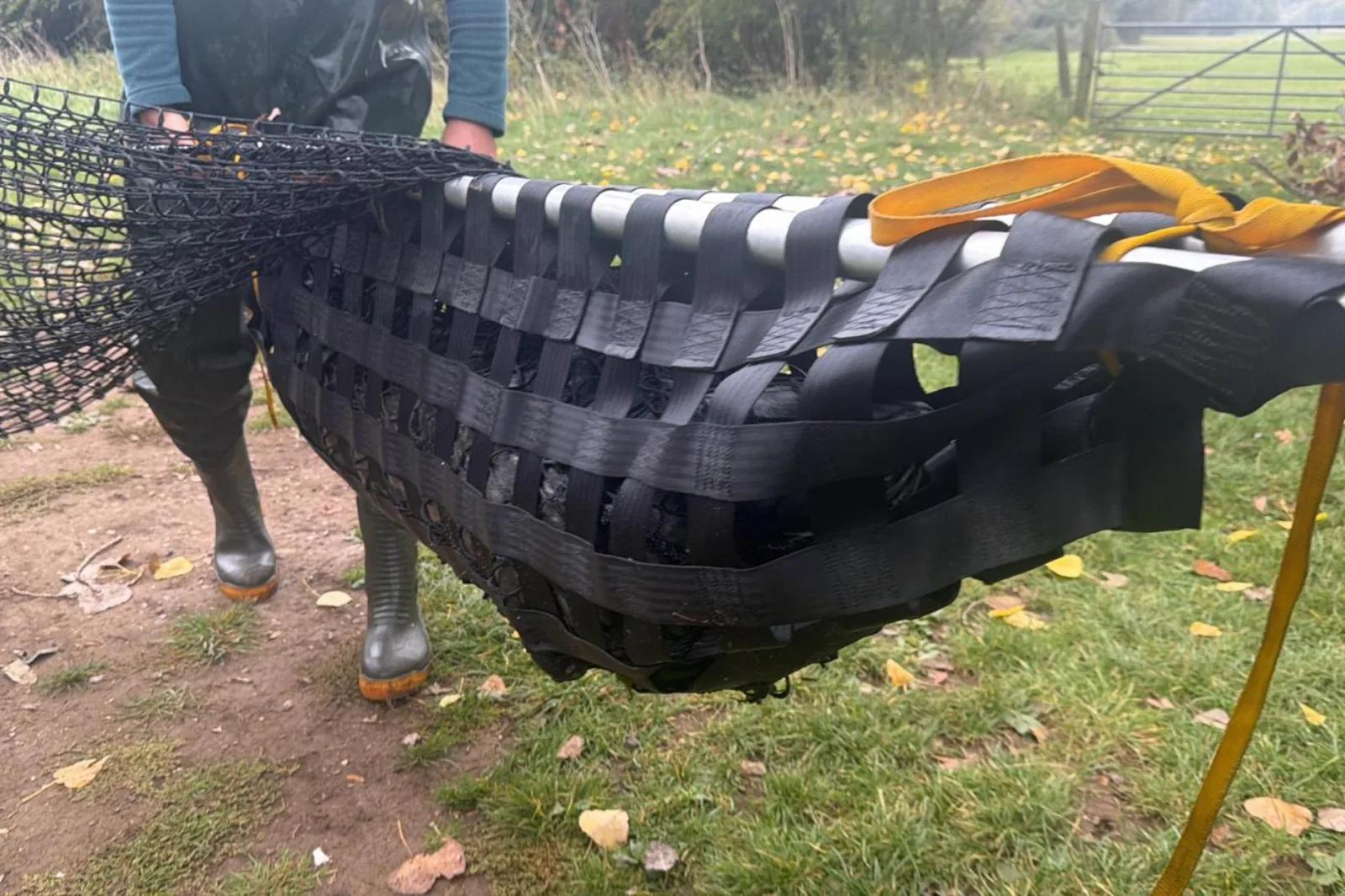
The capture operation on the Nene: specialist contractors, welfare-led handling, and the practical reality behind the licence.
8.3 Release
Daffodil was returned to RSPCA East Winch Wildlife Centre for several weeks of assessment before her coastal release at Horsey Beach, Norfolk in September 2025 – near where she had originally been found as a pup. Trifle, captured in September, spent additional time under observation at East Winch where staff worked to improve her condition; she was released at the coast in October 2025. Both were returned to locations with established common seal colonies to maximise successful reintegration.
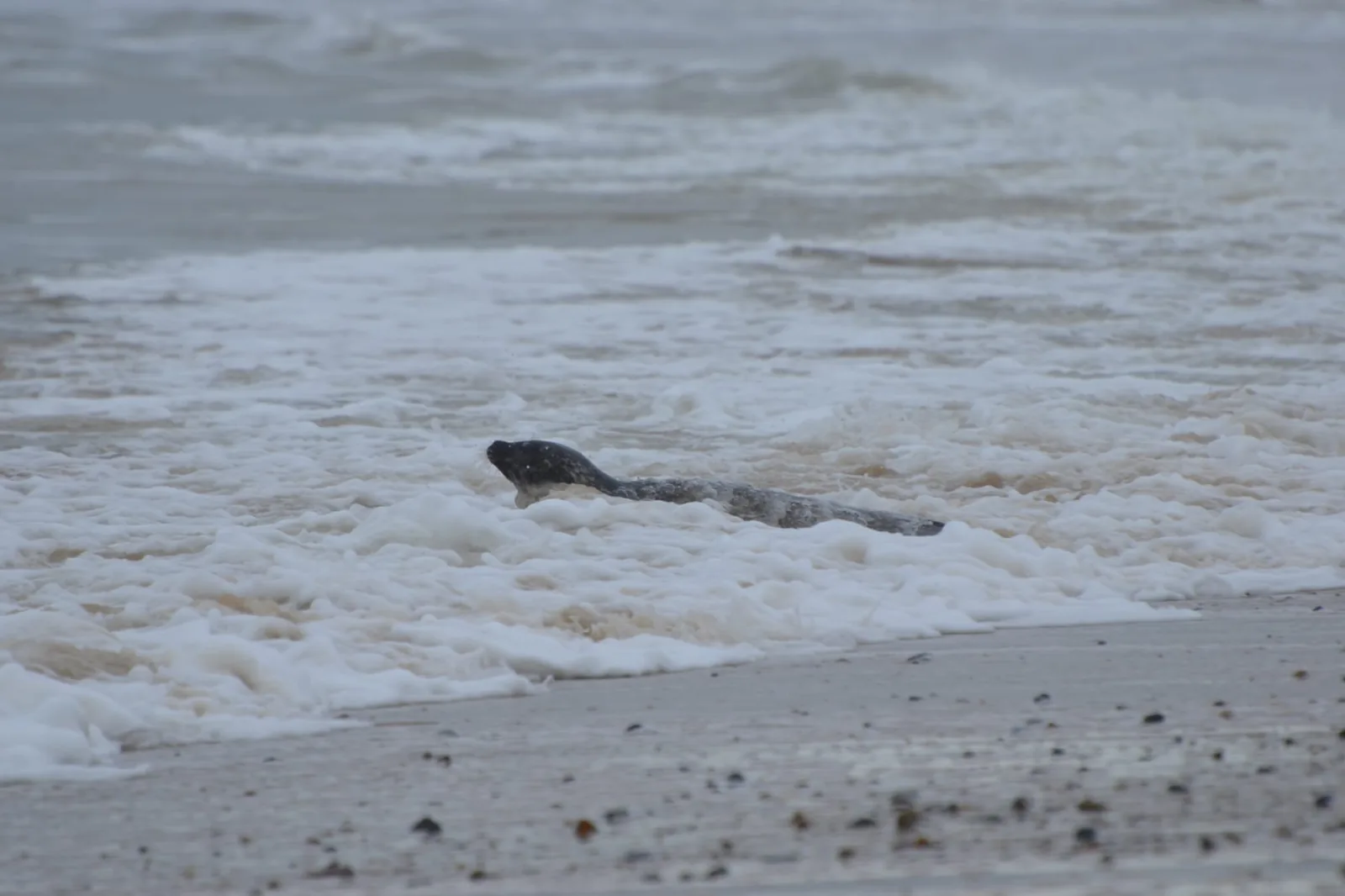
Coastal release at an established colony, the welfare-led outcome the entire campaign was built around.Photograph: Jake Davoile, Angling Trust
9. Outcomes and Impact
By October 2025:
- All resident common seals returned to coastal habitat
- RSPCA suspension of Sutton Bridge releases in place
- National freshwater acoustic deterrent protocol established
- Genuswave TAST proven in English freshwater
- Legal template for capture and relocation created
9.1 Fish Stock Recovery
Recovery will be measured in decades, not years. The EA’s 2025 survey found that the 25km stretch of river was almost devoid of adult fish. Breeding populations – the broodstock that produces the next generation – had been wiped out in most sections. Natural recruitment (fish breeding and repopulating on their own) will be very slow without adult fish to spawn.
P&DAA intends to work with the Environment Agency on a comprehensive restocking and habitat improvement programme. This will involve introducing juvenile fish to depleted sections, improving bankside habitat to provide refuges, and monitoring recovery through regular surveys. The EA’s assessment was that the river’s Water Framework Directive classification would have been downgraded – essentially a formal acknowledgement that the river’s ecological health has fallen below the Government’s minimum standard.
TAST devices will remain deployed as a precaution against returning seals.
9.2 National Precedents
The TAST protocol applies nationwide. The licensing pathway is a template for future applications. The case demonstrates that a determined volunteer club can navigate complex regulatory environments and achieve outcomes thought impossible.
9.3 Associated Costs
The following table provides an indicative breakdown of costs. Some figures are estimated ranges based on publicly available information about comparable operations. Clubs should use this as a planning framework; actual costs will vary. Blank rows are provided for additional site-specific costs.
| Cost Item | P&DAA Actual | Guidance for Others |
|---|---|---|
| Genuswave TAST device(s) – hire | £4,000 | £2,000 pcm per device |
| TAST deployment and maintenance | Included above | Budget separately if long-term |
| Ecologist assessment (for NE licence) | ~£1,000 | From ~£1,000 |
| IZVG – veterinary oversight | £6,000 | ~£2,000 per operational day |
| Marine and Wildlife Rescue – capture | Reduced rate (not disclosed) | Contact MWR directly |
| Seal transport (river to coast) | Included in MWR | May be separate |
| RSPCA assessment and coastal release | Provided by RSPCA | Contact RSPCA |
| Capture operation days (misc: boat hire, volunteer expenses, refreshments) | ~£3,000 | ~£1,000 per day |
| Communications and awareness campaigns | ~£1,200 | ~£40 pcm ongoing |
| Evidence gathering equipment | Nil (existing kit) | May need cameras, GPS |
| EA fish stock survey | Free | Free – contact your local EA Fisheries Technical Officer |
| Membership revenue loss (£30→£15 × ~2,000 members) | ~£15,000/year | Budget for reduced income |
| Travel and meetings | Nil (remote meetings) | 45p/mile if travel required |
| DIRECT CAMPAIGN SUBTOTAL | ~£15,200+ | |
| Fish stock restocking programme (post-removal) | £250,000–£300,000 est. | Species at £12–17/lb above cormorant predation size |
| Habitat restoration works (ongoing) | £15,000–£20,000/year | Alongside joint funding from other sources |
| TOTAL ESTIMATED COST (campaign + recovery) | £280,000–£335,000+ | |
The message is stark: the direct campaign costs were manageable for a volunteer club (£15,200), but the ecological recovery bill runs to hundreds of thousands of pounds. The restocking figure reflects the cost of fish above cormorant predation size (essential for establishing a breeding population rather than stocking fingerlings that will be eaten before they can reproduce). Every month of delay in addressing a seal situation increases the recovery cost dramatically.
10. Supporting Quotes
The following quotes are sourced from published media reports and official statements.
“You can’t put an overwhelming marine predator into an environment that can’t sustain it.”
“We see ourselves as the custodians of our water, and we will continue to seek the best possible outcome for all.”
“It is a great feeling that as a group of volunteers at an angling club we have helped to achieve this result, tackling this from the perspective of what is best for the seals, fish, people and the environment.”
“We do see it as a victory – from ‘just’ an angling club to get this, after such a long period of time.”
“It’s going to be a very long battle, we are talking decades to recover. Breeding populations being rebuilt will take decades. It’s a long way back but we have started the journey.”
“Meticulous planning went into the capture effort to ensure there was minimal disruption to the local area and low stress to the seals. Both were in reasonable health, although they had depleted the food source within the immediate area.”
“What has been so nice is the compassion shown by everyone for the welfare of the seals.”
“There are large sections of river in Peterborough with no fish in. The reduced numbers present have demonstrated large-scale change in their established behaviour. The relative timescale that this has happened in is short.”
“Each of these seals will consume vast amounts of freshwater fish, and one seal alone can decimate a fishery and cause profound damage to the ecosystem.”
“Stocks on the River Nene are particularly vulnerable to seal predation because the stretch of water had been historically straightened, leaving fish with nowhere to hide.”
Your Guide to Action
A practical template for clubs and fisheries facing the same issue
11. Template: Step-by-Step Guide
IMMEDIATE PRIORITIES – YOUR FIRST THREE ACTIONS:
- Start documenting now. Photograph every seal sighting, record dates, locations, and tag numbers. Deploy a Google Form for public reports.
- Contact GenusWave about TAST acoustic deterrent devices. Can be deployed in English freshwater without a separate licence.
- Report the situation to the Environment Agency (incident hotline: 0800 80 70 60) and request fish stock survey data for your waters.
The following framework distils P&DAA’s three-year experience into ten practical steps. Steps are in the order P&DAA found most effective, but circumstances will vary.
| Step | Action |
|---|---|
| 1 | Identify and document. Systematic evidence gathering. Photograph tags. Deploy sighting form. Distinguish transient from resident seals. |
| 2 | Assess the impact. Record catch changes. Request EA survey data. Quantify economic impact. Record safety incidents. |
| 3 | Establish the source. Determine if seals are wild or rehabilitated. Trace tags. Establish causal link to release practices. |
| 4 | Build a coalition. Work with neighbouring clubs. P&DAA’s 25-club coalition across three counties gave the campaign regional credibility. |
| 5 | Engage agencies constructively. Approach RSPCA, EA, Natural England, BDMLR as partners. Frame around shared objectives. |
| 6 | Deploy acoustic deterrents. Source Genuswave TAST as an immediate management measure. Freshwater protocol means no separate licence needed in England. |
| 7 | Engage specialist contractors directly. P&DAA engaged IZVG, Marine and Wildlife Rescue, and GenusWave. Build these relationships early. |
| 8 | Pursue the Natural England licence. Apply using Form A17. Free. 30-day target. Expect delays. Persist. |
| 9 | Execute the capture safely. Natural England licence, veterinary oversight, specialist handling. Release at coastal sites with established colonies. |
| 10 | Plan for recovery. Baseline surveys. Restocking. Habitat improvement. Monitor for returning seals. Deploy TAST as needed. |
12. Key Contacts and Resources
The following organisations were involved in the River Nene seal operation. Website and email details are provided where publicly available. Clubs facing similar issues should use this as a starting point for engagement.
| Organisation | Details |
|---|---|
| Peterborough & District Angling Association (P&DAA) |
Led the entire campaign from evidence gathering through to rescue coordination. Web: www.fishinginpeterborough.co.uk Email: support@fishinginpeterborough.co.uk |
| GenusWave Ltd |
Manufacturer of Targeted Acoustic Startle Technology (TAST). Developed with the University of St Andrews. Web: genuswave.com Email: info@genuswave.com |
| Natural England |
Licensing authority for capture/relocation of protected species. Issues licences under the Conservation of Habitats and Species Regulations 2017. Seal licence: Form A17. Web: gov.uk/government/publications/seals-apply-for-a-licence-to-kill-or-take-them Email: enquiries@naturalengland.org.uk |
| Environment Agency |
Fish stock monitoring, environmental regulation, rod licence income. Conducts fish population surveys. Web: gov.uk/government/organisations/environment-agency Incident hotline: 0800 80 70 60 |
| RSPCA East Winch Wildlife Centre |
Specialist seal rehabilitation centre in Norfolk. Responsible for seal release practices. Web: rspca.org.uk/local/east-winch-wildlife-centre RSPCA helpline: 0300 1234 999 |
| International Zoo Veterinary Group (IZVG) |
Largest full-time freelance zoological veterinary practice in the world. Founded 1976. Based in Keighley, West Yorkshire. Provided veterinary oversight for capture and relocation. Web: www.izvg.co.uk Email: office@izvg.co.uk | Tel: 01535 692 000 |
| Marine and Wildlife Rescue |
Norfolk-based volunteer wildlife rescue charity. Founded 1990, based in Great Yarmouth. Led the practical seal capture operation on the River Nene. Dan Goldsmith. Web: www.marineandwildliferescue.org.uk Email: info@marineandwildliferescue.org.uk | Tel: 01692 650338 |
| British Divers Marine Life Rescue (BDMLR) |
National marine mammal rescue charity. Network of trained volunteer Marine Mammal Medics across the UK. Web: bdmlr.org.uk Email: info@bdmlr.org.uk | Rescue hotline: 01825 765546 |
| Angling Trust |
National representative body for angling in England. Supported P&DAA’s campaign to change RSPCA release practices at Sutton Bridge. Web: anglingtrust.net Seals in Freshwater guidance: anglingtrust.net/predation-2/seals-around-the-british-isles/seals-in-freshwater/ |
13. Lessons Learned
13.1 What Worked
Early and systematic evidence gathering made the case undeniable. Framing around shared welfare objectives built constructive relationships. The 25-club regional coalition prevented dismissal as parochial. Taking direct responsibility for engaging contractors was essential. Genuswave TAST provided a proven, humane tool. Persistent engagement over hundreds of volunteer hours drove every breakthrough.
13.2 What Was Challenging
The speed of ecological damage versus bureaucratic process was the most frustrating mismatch. Multi-agency governance with no single problem-owner made coordination difficult. Public perception of seals as a novelty required careful communication. The volunteer time demand was significant and unsustainable over three years.
The licence carried an important condition that other clubs should plan for: if any released seal returns to the river, all further capture attempts must be suspended pending discussion with Natural England. The campaign therefore had to remain prepared for that scenario throughout the operational window. Robust monitoring after each release is not optional, it is licence-mandated.
13.3 What P&DAA Would Do Differently
Engage specialist contractors even earlier. Push for baseline fish stock data before deterioration begins. Deploy Genuswave TAST as soon as seal residency is confirmed, rather than waiting for agency permission. Apply for the Natural England licence proactively, even before all parties agree it is needed.
14. The Wider Debate: Seal Management Perspectives
This section sets out the principal arguments from different perspectives. The River Nene case sits within a broader discussion about recovering marine predator populations and their interactions with freshwater ecosystems.
The case for intervention
The Environment Agency’s data showed catastrophic decline – around 90% across surveyed open-water sections, and 100% in three middle stretches where fish numbers fell from previous baselines to zero. The EA’s 2025 report stated the impact on wider ecology for mammals, birds, and invertebrates would be wide-ranging and large-scale. The seals were rehabilitated animals released at an inland tidal location, not wild animals that had naturally migrated. The Nene’s lock-divided structure, with no longitudinal passage for coarse fish, made it uniquely vulnerable in ways open marine environments are not.
The RSPCA’s position
The RSPCA stated that seals are protected by law and rivers are a natural habitat for them. The charity referenced its 2004 satellite tracking study showing Sutton Bridge releases gave seals a good start back at sea. Following intervention, the RSPCA suspended releases and moved to alternative coastal locations, stating it would gather data and consult with partners. For further context, the Angling Trust’s Seals in Freshwater guidance provides a national overview.
The conservation context
Some harbour seal populations do naturally inhabit freshwater lakes internationally (Lac des Loups Marins, Quebec; Iliamna Lake, Alaska), demonstrating seals are not biologically incapable of freshwater life. However, these are established, self-sustaining populations in large water bodies – fundamentally different from rehabilitated animals becoming stranded in a lock-divided urban river with a finite, declining food supply. UK common seal (harbour seal) populations have declined in some regions while grey seal numbers have increased, making conservation status a factor in management decisions.
The scientific position on deterrence
The peer-reviewed literature is clear that conventional ADDs cause habituation, hearing damage, and habitat exclusion of non-target species such as harbour porpoise. Götz and Janik’s long-term trial (2016, Animal Conservation) demonstrated TAST achieves 91–97% predation reduction with no impact on porpoise or otter distribution – the strongest evidence for any non-lethal marine predator deterrent. This scientific foundation was central to P&DAA’s case and Natural England’s acceptance of the freshwater acoustic deterrent protocol.
15. Conclusion
The River Nene seal case is the story of a volunteer-run angling club, founded in 1875, taking on a challenge many considered impossible – and succeeding through determination, self-reliance, and an unwavering commitment to doing the right thing for every species involved.
Five common seals inadvertently released into a freshwater river were safely captured and returned to their coastal habitat. The fish, the ecosystem, the seals, and the community all benefited.
P&DAA’s campaign has created a national template. The Genuswave TAST protocol, the licensing pathway, the coordination model, and the capture methodology are all now established and available.
As Rob Harris reflected: it is a great feeling that a group of volunteers at an angling club helped achieve this result. Every ecology has its balance. You cannot have an overwhelmingly large predator in a small environment. You could not put a shark in a fish tank.
The job now turns to recovery. It will take decades, but the journey has begun. For any club facing a similar challenge, the message from Peterborough is clear: it can be done. Contact P&DAA or the organisations listed in Section 12 for guidance.
For further information or to discuss a similar situation:
Peterborough & District Angling Association
www.fishinginpeterborough.co.uk · support@fishinginpeterborough.co.uk
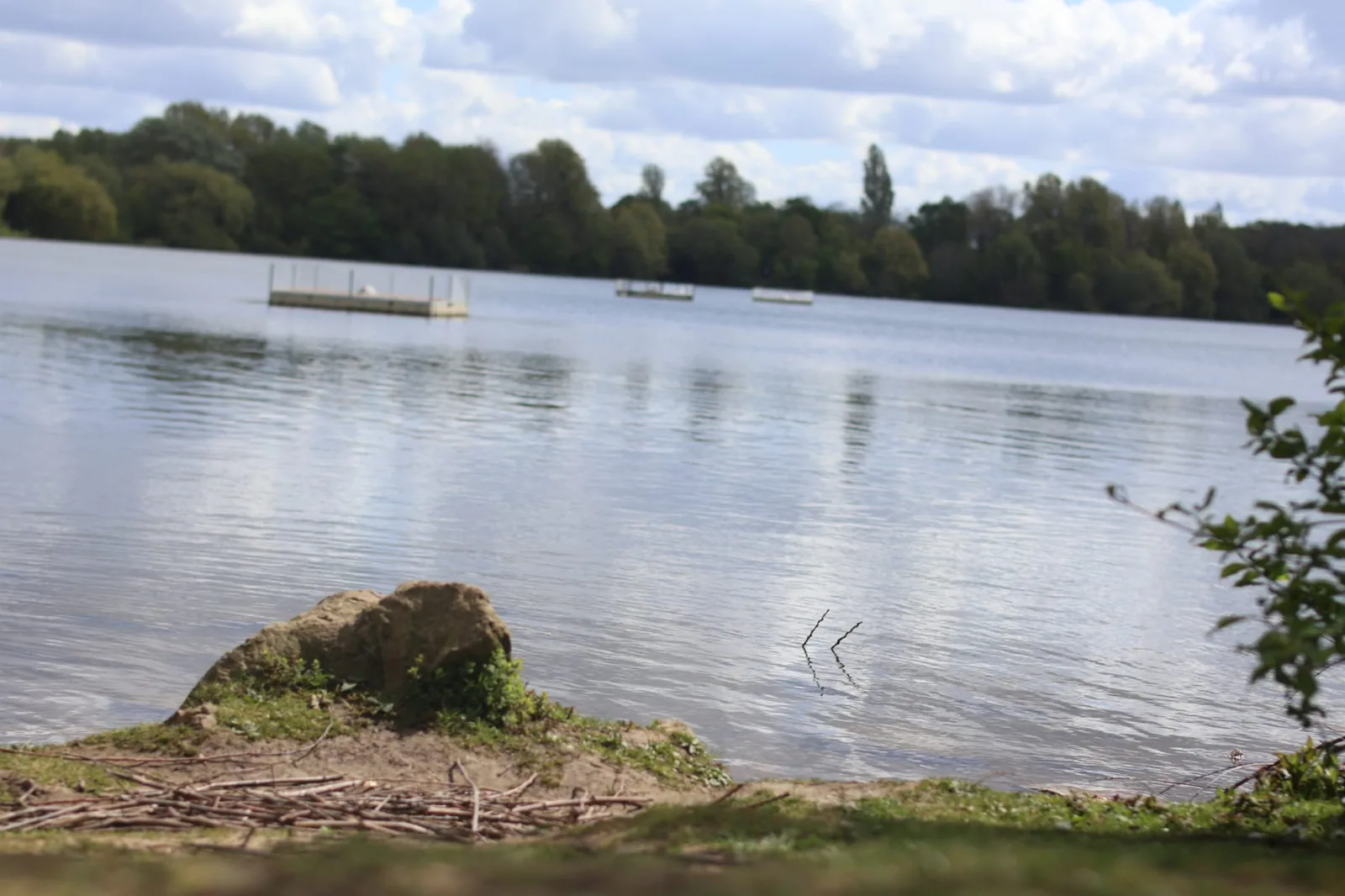
Looking forward, the team behind the case, and the water now beginning to recover.
16. References and Sources
The following sources were consulted in the preparation of this case study. References are listed alphabetically by author/organisation.
Angling Trust (2024a). ‘Angling Trust calls for RSPCA to stop releasing seals on tidal River Nene.’ 2 April 2024. anglingtrust.net
Angling Trust (2024b). ‘Angling Trust welcomes RSPCA’s decision to suspend releasing rescued seals at Sutton Bridge.’ 30 April 2024. anglingtrust.net
Angling Trust (2025). ‘Angling Trust & Fish Legal support successful seal relocation in partnership with P&DAA.’ 8 October 2025. anglingtrust.net
Angling Trust (n.d.). ‘Seals in Freshwater.’ anglingtrust.net/predation-2/seals-around-the-british-isles/seals-in-freshwater/
BBC News (2024). ‘Seal releases halted after fish stock concerns.’ 1 May 2024. bbc.co.uk
Conservation of Habitats and Species Regulations 2017 (SI 2017/1012). legislation.gov.uk
Environment Agency (2024). Fish stock survey report, River Nene, Peterborough.
Environment Agency (2025). River Nene Fisheries Survey Summary, February 2025. LNA A&R Team. [Primary source document.]
GenusWave (n.d.). ‘Targeted Acoustic Startle Technology.’ genuswave.com
Götz, T. and Janik, V.M. (2010). ‘Aversiveness of sound in phocid seals.’ Journal of Experimental Biology, 213, pp.1536–1548.
Götz, T. and Janik, V.M. (2011). ‘Repeated elicitation of the acoustic startle reflex leads to sensitisation.’ BMC Neuroscience, 12:30.
Götz, T. and Janik, V.M. (2013). ‘Acoustic deterrent devices to prevent pinniped depredation.’ Marine Ecology Progress Series, 492, pp.285–302.
Götz, T. and Janik, V.M. (2015). ‘Target-specific acoustic predator deterrence.’ Animal Conservation, 18(1), pp.102–111.
Götz, T. and Janik, V.M. (2016). ‘Non-lethal management of carnivore predation: long-term tests with a startle reflex-based deterrence system on a fish farm.’ Animal Conservation, 19, pp.212–221. DOI: 10.1111/acv.12248. [Primary source document.]
Hammond, P.S. and Wilson, L.J. (2016). ‘Grey Seal Diet Composition and Prey Consumption.’ Scottish Marine and Freshwater Science, Vol 7, No 20.
ITV News Anglia (2024). ‘Anglers call for RSPCA to stop seal releases in River Nene.’ 17 April 2024. itv.com
IZVG / Marine and Wildlife Rescue (2025). ‘Translocation of Grey Seals from the River Nene to the Norfolk Coast – Method Statement.’ [Primary source document. Document title uses ‘Grey Seals’; the seals translocated were common seals (Phoca vitulina).]
Natural England (2022). ‘Seals: apply for a licence to kill or take them.’ Form A17. gov.uk
NOAA Fisheries (n.d.). ‘Harbor Seal.’ fisheries.noaa.gov/species/harbor-seal [US terminology; common seal/harbour seal in UK. Daily consumption data.]
P&DAA (2024a). ‘Tackling the Seals.’ January 2024. fishinginpeterborough.co.uk
P&DAA (2024b). ‘Seal Releases at Sutton Bridge.’ May 2024. fishinginpeterborough.co.uk/seal-releases-at-sutton-bridge/
Peterborough Today (2024a). ‘Call for action to move Peterborough’s seal population back to the coast.’ 16 April 2024. peterboroughtoday.co.uk
Peterborough Today (2024b). ‘Peterborough angling club claims victory in row with RSPCA over seals.’ 9 May 2024. peterboroughtoday.co.uk
Peterborough Today (2025a). ‘Peterborough anglers concerned over ‘dire’ and ‘unprecedented’ drop in River Nene fish numbers.’ 4 June 2025. peterboroughtoday.co.uk
Peterborough Today (2025b). ‘Anglers celebrate ‘victory for all’ as seals relocated from River Nene.’ 7 October 2025. peterboroughtoday.co.uk
RSPCA (2004). Satellite tracking study of rehabilitated seal releases at Sutton Bridge. Referenced in RSPCA statements (2017, 2024).
The Cool Down / Yahoo News (2025). ‘Rescuers respond after ocean creatures are found far from where they belong.’ 7 November 2025.
Walmsley, S. et al. (2025). ‘Effectiveness of TAST on seal depredation in an inshore gillnet fishery.’ Fisheries Research, 281, 107178.
What’s The Jam (2025). ‘Lost seals who spent three years stranded in river 40 miles from sea rescued.’ 9 October 2025.
Glossary of Key Terms
This glossary explains technical terms used in the case study in plain English.
| Term | What it means |
|---|---|
| ADD | Acoustic Deterrent Device. An underwater loudspeaker system designed to keep seals away. Conventional ADDs play continuous noise and seals learn to ignore them. TAST is a newer, more effective type. |
| Broodstock | Adult fish of breeding age. These are the fish that produce the next generation. When broodstock are lost, recovery depends on restocking or waiting for juveniles to mature – which takes years. |
| Coarse fish | Freshwater fish species other than salmon and trout. In the Nene this includes bream, roach, barbel, pike, perch, carp, tench, and zander. |
| EA | Environment Agency. The Government body responsible for monitoring fish populations, issuing rod licences, and protecting the water environment in England. |
| EPS | European Protected Species. Animals and plants given the highest level of legal protection. Both common seals and grey seals are EPS in England. |
| Form A17 | The official application form used to apply for a Natural England licence to capture or relocate seals. Free to submit. Available at gov.uk. |
| Common seal | Phoca vitulina, also known as the harbour seal. The smaller of the two UK seal species. Adult females weigh 80–100kg. They eat an average of 3–5kg of fish per day. All five Nene seals were common seals. |
| Haul out | When a seal climbs out of the water onto land or a bank to rest, digest food, or warm up. Seals spend significant time hauled out and are most visible (and approachable) in this state. |
| Natural England | The Government’s adviser on the natural environment in England. Responsible for issuing licences to handle protected species such as seals. |
| Sensitisation | The opposite of habituation. With TAST, repeated exposure makes seals more cautious and more likely to avoid the area – not less. This is what makes TAST effective long-term. |
| Sonar survey | A method used by the EA to estimate fish populations. A boat-mounted sonar device sends sound waves into the water and counts the echoes from fish. Best done in winter when weed dies back. |
| TAST | Targeted Acoustic Startle Technology. A Genuswave device that emits short, sharp underwater signals to trigger the seal’s involuntary startle reflex, causing it to flee. Does not harm seals or other wildlife. |
| WFD | Water Framework Directive. The Government’s standard for measuring river health. Rivers are classified from ‘High’ to ‘Bad.’ The EA said the Nene would have been downgraded due to seal predation. |
Appendices
The following appendices are provided as supplementary material for clubs and organisations using this case study as a template.
Appendix A: Natural England Seal Licence – Form A17
gov.uk/government/publications/seals-apply-for-a-licence-to-kill-or-take-them
Clubs are advised to download and review these forms early in the process, even before an application is contemplated, to understand the evidence requirements and welfare safeguards that Natural England will expect.
Appendix B: P&DAA Seal Sighting Report Form
P&DAA deployed an online seal sighting report form, accessible via their website and app. The form was designed to collect structured, confidential reports from the public. Other clubs can replicate this approach using a free Google Form or similar tool. The P&DAA form collects the following fields:
| Field | Purpose |
|---|---|
| Date of sighting | Calendar date picker. Essential for tracking residency duration and patterns. |
| Time | Time of day. Helps establish daily activity patterns and haul-out schedules. |
| Venue | Dropdown of known locations. Enables location-specific tracking across the river system. |
| Location description | Free text. Allows precise detail beyond the venue dropdown. |
| What3Words reference | Optional. Provides exact GPS-level location without requiring coordinates. |
| Description of seal | Free text. Activity, behaviour, feeding, number of seals, tag numbers if visible. |
| Seal tag number | Dedicated field. Critical for identifying individual animals and linking to release records. |
| Image upload | Photo/video upload (multiples allowed). Visual evidence of tags, condition, and behaviour. |
The form header includes clear public safety messaging: ‘Please do not approach any seals or cause them any distress. Keep your distance.’ It provides the BDMLR rescue hotline (01825 765546) and RSPCA helpline (0300 1234 999) for injured or distressed animals, and is accompanied by an infographic explaining how to give seals space.
Clubs setting up their own reporting system should ensure: reports are confidential (to encourage participation without fear of social media attention); data is structured (dropdowns, not just free text) to enable analysis; and image upload is available for tag identification.
Sighting report form template, a reusable design for freshwater monitoring, based on P&DAA's deployed structure and adaptable for any club or fishery.
Appendix C: Environment Agency Fish Stock Survey Data
The complete EA sonar fish stock survey data for the River Nene is presented in Figure 1 of this case study (Section 3.3). The data is drawn from the following official report:
Environment Agency (2025). River Nene Fisheries Survey Summary, February 2025.
Originating team: LNA A&R Team.
This report covers six survey locations across the lower Nene around Peterborough, comparing data from 2019, 2021, 2023, 2024 and 2025. It was produced specifically to assess the impact of seals becoming resident in the river.
The full report is available from P&DAA on request. Clubs facing a similar situation should contact their local EA Fisheries Technical Officer to request a baseline fish stock survey. This service is provided free of charge by the Environment Agency, funded by rod licence income. Many clubs are unaware this service exists. The EA customer service line is 03708 506 506, or email enquiries@environment-agency.gov.uk and ask to be connected to your local fisheries team.
Appendix D: Correspondence Log Template
Maintaining a detailed correspondence log was essential to P&DAA’s campaign. The following template can be used by other clubs to track all communications with agencies. Keeping meticulous records demonstrates professionalism, provides evidence of engagement, and is invaluable when progress stalls.
| Date | Contact | Organisation | Subject / Action | Follow-up |
|---|---|---|---|---|
| 15/01/24 | Jane Smith | Natural England | Initial enquiry re: seal licence | Directed to Form A17 |
| 28/03/24 | CEO | RSPCA | Formal letter re: Sutton Bridge releases | Suspension 30/04 |
| 10/05/24 | FTO name | Environment Agency | Request for fish stock survey | Survey confirmed |
| 15/06/24 | Dan Goldsmith | Marine and Wildlife Rescue | Initial contact re: capture | Meeting arranged |
| 01/09/24 | Vet name | IZVG | Method statement discussion | Draft received |
Tips: save all emails and letters. Note the name and role of every person you speak to. Follow up verbal conversations with a confirming email. Record response times – if an agency takes weeks to reply, this is evidence of delay that strengthens your case.
Facing the same situation?
If your club or fishery is dealing with a similar protected predator conflict, P&DAA can share what was learned. Get in touch — or take the full case study with you.
Peterborough & District Angling Association is a volunteer-led angling club founded in 1875, controlling approximately 12 miles of the River Nene through and around Peterborough.
fishinginpeterborough.co.uk · support@fishinginpeterborough.co.uk