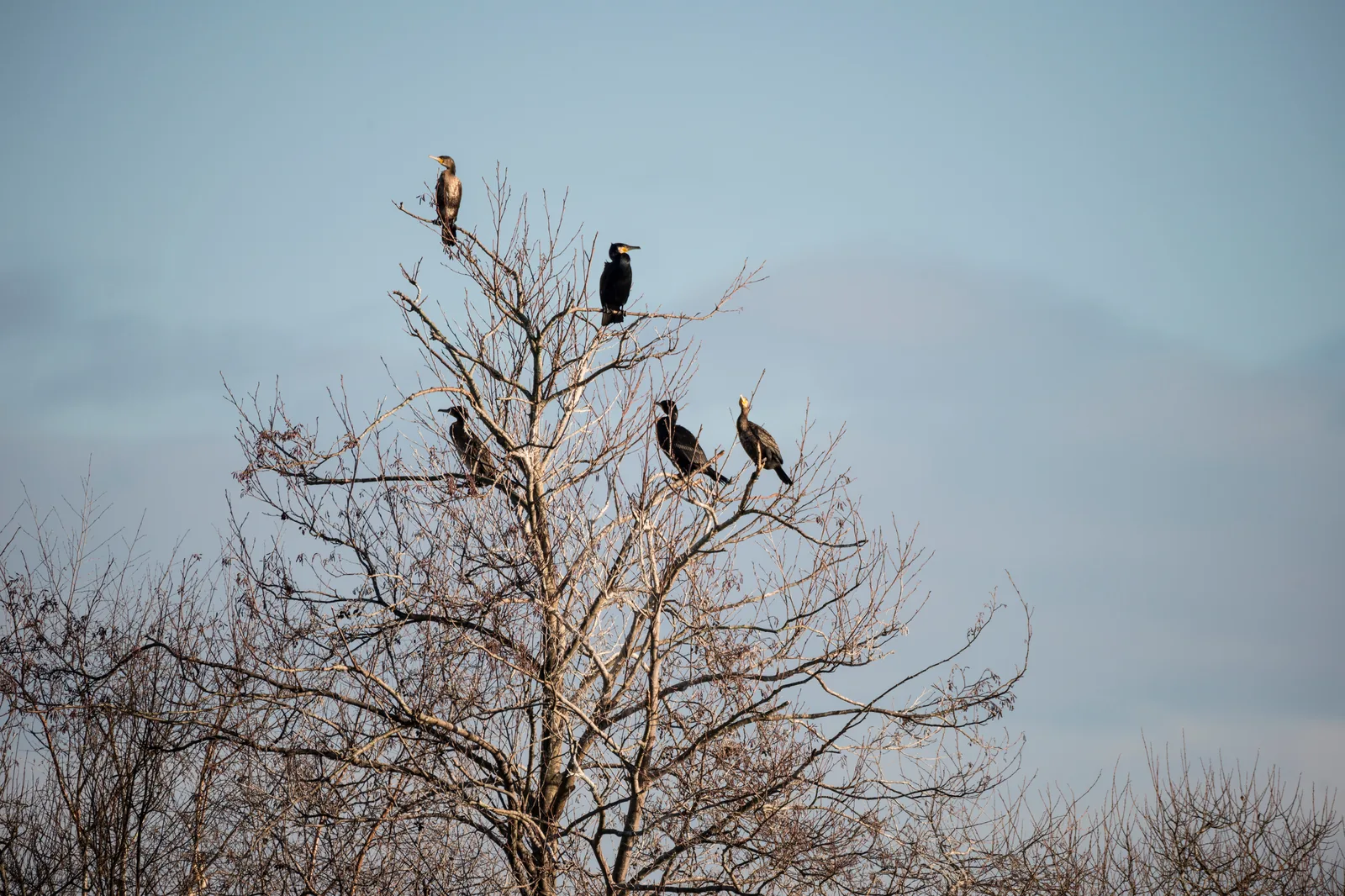
A cormorant roost kills the trees it occupies. The guano is mostly uric acid. It burns the bark, kills the leaves, and within a few years a stand of riverside oaks or willows becomes a row of white-streaked skeletons.
That's a small piece of what cormorant predation does on UK inland water. The fish loss is the famous part. The rest of the damage is less famous, and what disappears alongside the fish is less famous still.
This piece isn't about anglers. It's about what cormorants do to a river system and what an empty river does to everything that lives off it.
The familiar argument
When anglers raise cormorant predation as a problem, the response is reliably the same. Anglers want the fish for themselves. Cormorants are protected native birds doing what birds do. The complaint is dressed-up self-interest.
Take the argument at its strongest first. The native UK coastal cormorant population is protected for sound conservation reasons. Some historical predation control was unscientific and excessive. Anglers do benefit when fish stocks are healthy.
Now check the arithmetic. UK coarse angling is the sector that runs into cormorant pressure most directly. It's also the sector where catch and release isn't a movement, it's the default. Pike anglers return every fish, by rule and by culture. Specimen carp anglers return every fish. Match anglers return every fish. Taking coarse fish these days is entirely unheard of by law-abiding anglers.
A cormorant on UK inland water takes around half a kilo of fish a day on average. The bioenergetics modelling for wintering birds at Loch Leven (Grémillet and colleagues, Journal of Applied Ecology, 2003) puts mean daily food intake at 510 grams, with potential daily figures running close to a kilogram in cold conditions or for breeding adults. Across a year that's somewhere between two hundred and three hundred kilograms per bird. A roost of thirty birds working a stretch removes several tonnes of fish a year.
An angler practising catch and release takes nothing.
The "competing for fish" framing doesn't survive that comparison.
The real question becomes a different one. Not what anglers are taking. What everything else is losing.
What cormorants do beyond the fish
The roost-tree death is visible from any boat. You can see it from a road. Whole stretches of riparian woodland have become white-streaked skeletons because a cormorant flock chose them. The trees aren't recovering. They're dying in place, leaving gaps in the bank line that take decades to fill, if they fill at all.
A river without bankside trees changes character. Shade disappears, water temperatures rise, leaf litter inputs drop, and otters lose holt sites and resting cover. The cormorants move on when the trees are gone. The river they leave behind isn't the same river.
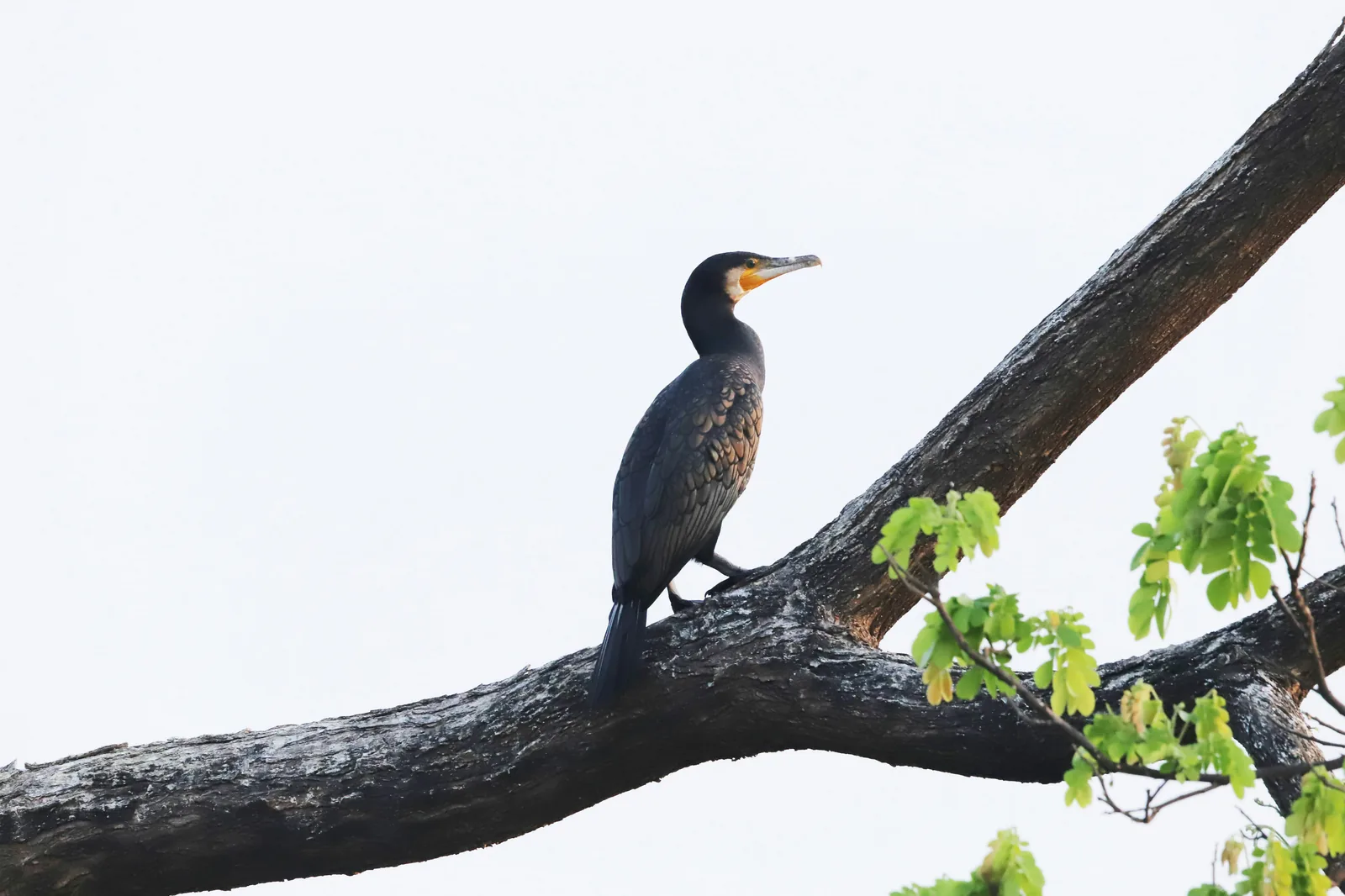
There's something specific about this that gets missed. UK inland cormorant numbers aren't natural background levels. The bird at the roost isn't quite the bird Britain had through most of the twentieth century. The first inland tree-nesting cormorant colony in the UK was established in 1981 at Abberton Reservoir in Essex. The birds were the continental subspecies Phalacrocorax carbo sinensis, which had been extending its range across Europe on the back of fish-farm food availability and milder winters. Year-round food supply subsidised by aquaculture produced a wave of birds that pushed west and north. By the 1990s, inland breeding in the UK was established. By 2005 there were roughly 2,100 sinensis pairs in Britain (Newson and colleagues, British Birds, 2007). By the 2010s the inland nesting population was widespread across England. Most of the cormorants on UK inland waters now belong to sinensis, not to the smaller native UK coastal carbo population.
UK law protects cormorants as a single species. It was written around the native coastal population before the sinensis expansion happened. The native birds the law was written to protect are the minority. The non-native birds it protects in practice are the majority.
A coastal subspecies taking marine fish from coastal waters is one thing. A continental subspecies in five-figure inland numbers, sitting on UK rivers and stillwaters every day of the year, is a different thing operating on a different system.
The BTO Heronries Census, the longest-running breeding-bird monitoring scheme in the world, now records both cormorant and grey heron nesting at shared inland sites. Cormorants are aggressive at roost. Studies from North America and Korea have documented cormorants competing with heron species for nest sites and damaging shared nest trees through concentrated guano. The mechanism doesn't change with geography. The UK grey heron population hasn't recovered from declines following the severe winters of 2008/09 and 2010/11, and the inland tree-nesting cormorant population now sits inside the same nest-tree resource. Bankside trees suitable for heron nesting aren't unlimited.
At concentrated roost sites, the guano does more than kill trees. It loads small water bodies with nitrogen and phosphorus. A lake under a regular roost can shift its nutrient regime over years. The visible damage is white-streaked branches and dying canopy. The less visible damage is what happens to the water below the roost. Algal blooms, weed bed shifts, and oxygen profile changes follow eutrophication. None of this shows up in a "cormorants ate the fish" headline because it isn't a fish story.
The loading is concentrated and continuous. Birds come back, birds defecate, birds leave. The cycle runs every day of the year. Catchment-level nutrient management plans don't account for this input because the source isn't fixed infrastructure. The phosphorus and nitrogen budgets that water companies and farmers work to optimise sit alongside a bird-driven input that no statutory body manages.
Then there's the predator pile-up. Cormorants share fish prey with kingfishers, grey herons, great crested grebes, goosanders, mergansers, mink, and otters. The cormorant doesn't take fish in a vacuum. It takes fish from a shared resource that everything else above the fish in the food web also depends on. When cormorant pressure is high and fish biomass is low, every other native predator competes for what's left. Kingfishers and grebes lose first because they're smaller, less mobile, and territorial. Otters can shift territory but at population cost. The cormorant is the bird eating well in this picture. Everything else gets thinner.
Bank erosion at high-pressure roosts is a smaller piece of the puzzle but worth naming. Heavy bird usage strips ground cover under the roost. Heavy ground cover removal accelerates bank erosion at the bend or island the roost sits on. Sediment loads downstream rise. Spawning gravels silt over. The visible result is simple. A river with degraded banks has fewer of the redd sites that recruit the next generation of fish.
The damage so far has been about what cormorants do. The other half of the story is what isn't there once they've fed.
What an empty river does
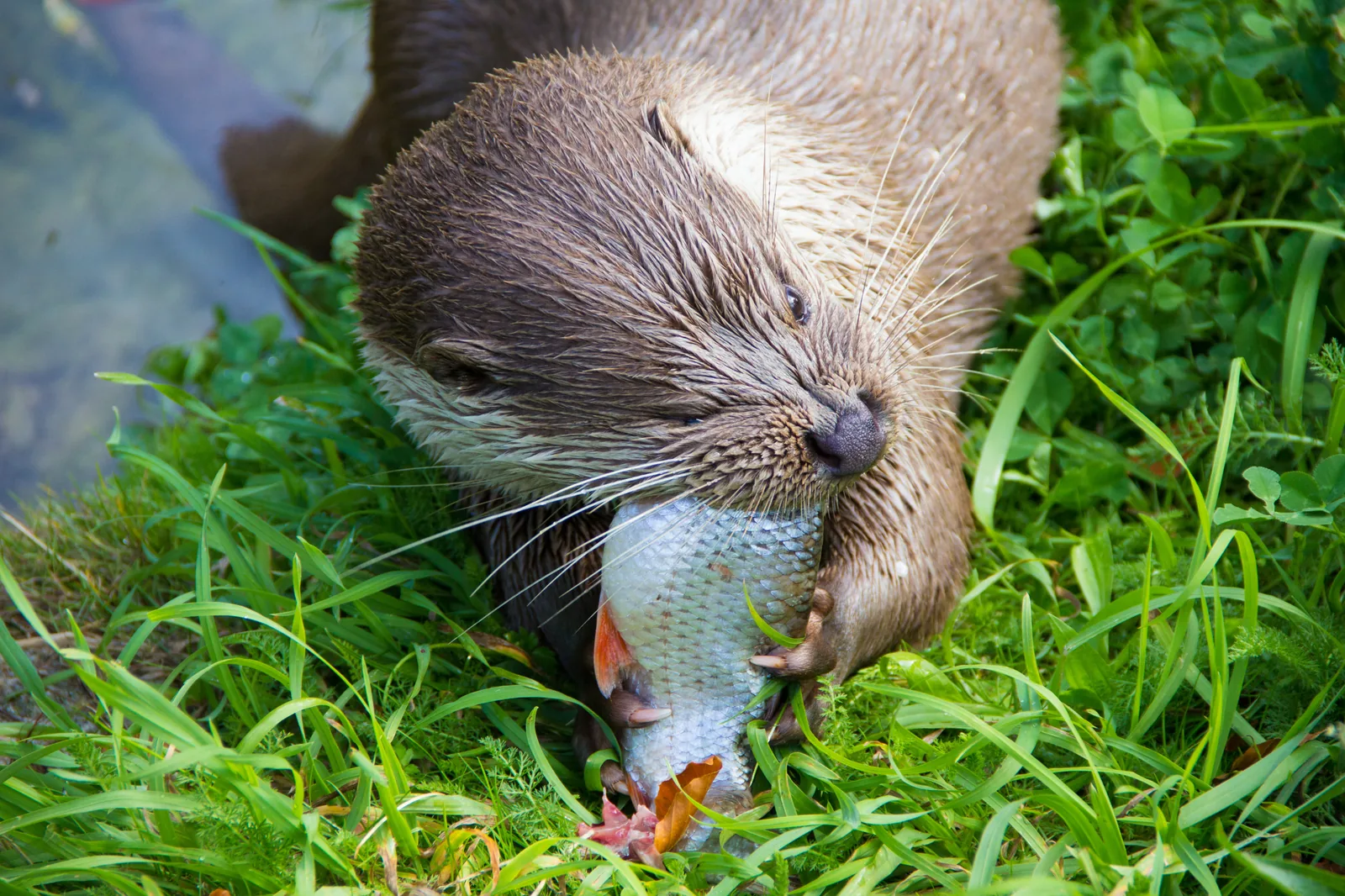
An adult otter on UK inland water needs around a kilogram of fish a day. A breeding female with cubs needs more. The figure comes from Chanin and from the standing river-otter ecology literature. It isn't a target. It's what the animal requires to live.
On a river with abundant fish, that requirement is straightforward. The otter takes what it needs and the system carries the cost easily. On a river with depleted fish stocks, that kilogram becomes harder to find. Territory sizes increase. Density drops. Breeding success falls. The otter doesn't crash visibly. It slowly thins out, on a scale of years rather than seasons. The decline is the kind that takes decades to read because it's a population-density signal rather than a presence-absence signal. Otter conservation work in this country has been one of the genuine wildlife success stories of the last forty years. It depends, at the bottom of the food web, on fish biomass.
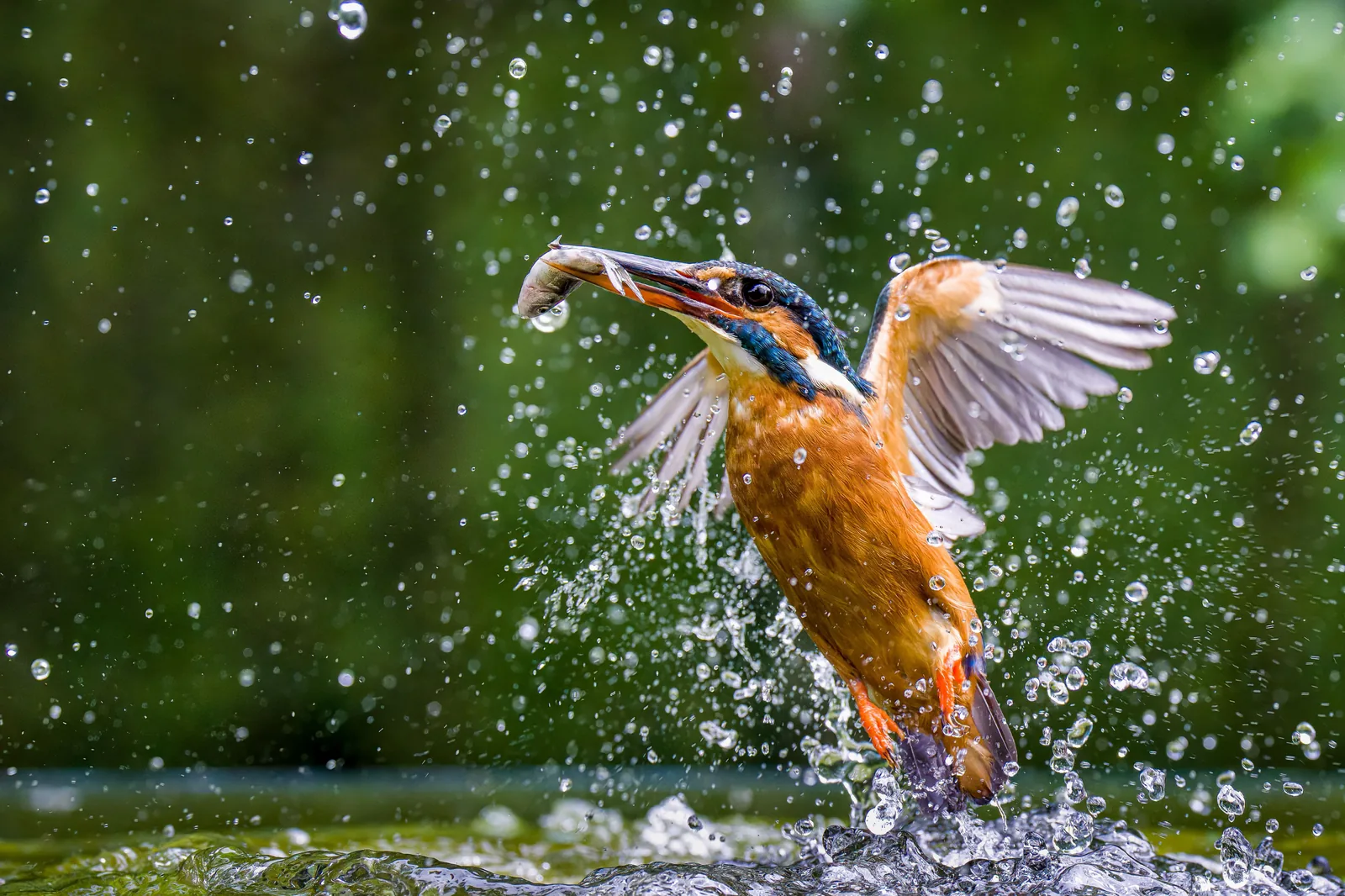
The same applies to kingfishers. The kingfisher hunts visually, by diving from a perch into water clear enough to see fish at depth. Two conditions need to be met for a kingfisher to feed. Fish need to be there. The water needs to be clear enough to see them. A river that's been heavily cormorant-cropped can be perfectly clear and still hold no kingfishers, because it holds no fish small enough at densities high enough to make hunting energetically worth it.
Great crested grebes, goosanders, mergansers, grey herons. All of them depend on a fish base. They are the wildlife you see at the water when you're looking. They are also the wildlife you stop seeing when the fish are gone. The relationship isn't subtle. Predators above fish in the food web need fish. The fact that cormorants are also above fish in the food web doesn't change the dependency for everything else.
The cascade goes further than the obvious species. Fish populations exert grazing pressure on invertebrate communities and indirectly on macrophyte communities. Remove the fish from a shallow lake and the invertebrate community changes within a few seasons. The grazing pressure on weed and detritus shifts. Macrophyte communities respond. In the worst cases, a clear-water shallow lake flips into a turbid-water state with algal dominance. The mechanism is the alternative-stable-states model that lake ecologists have spent more than three decades documenting (Scheffer and colleagues, 1993 onward). Nutrient loading is the primary driver. Fish community disruption is one of the inputs that can tip a lake between states.
Dead-fish biomass matters in a way that's easy to overlook. Fish die. Fish bodies feed mink, raptors, scavenging birds, otters when other prey is short, and a quiet community of invertebrates and microbes that close the nutrient loop. When fish populations are healthy, this flow is constant and largely invisible. When fish populations collapse, the flow stops, and the scavengers and decomposers that fed off it go with it.
Specific cases sit alongside the general pattern. The River Wye salmon decline is the most documented and the most public. The causes are multi-factor, including chicken-farm run-off, low summer flows, and warming water temperatures. Smolt predation by cormorants and goosanders is one named factor. The Wye and Usk Foundation cites a 1999 MAFF survey finding that up to 98% of salmon parr produced on the Upper Wye were taken by goosanders, with cormorants present in groups of up to 55 birds. More recent peer-reviewed work has tracked the same dynamic on other rivers. Chavarie and colleagues followed Atlantic salmon smolts down the River Endrick in Scotland and attributed around 42% of in-river mortality to avian predation, with goosanders and grey herons identified as the principal predators (Ecosphere, 2022). The fish that don't make it to sea aren't there to come back. The Wye is one case. The pattern of fish-stock collapse interacting with predation pressure isn't reducible to anglers wanting more fish to catch.
Counting the wildlife that depends on fish is straightforward enough as long as someone is counting. The official UK wild bird statistics show great crested grebe down by around a third in the UK since 1994, with the decline continuing strongly in the most recent five-year period. The BTO Heronries Census records grey heron numbers still well below the early-2000s peak of around 13,000 nests, with no recovery from the cold-winter declines of 2008/09 and 2010/11. The Otter Project monitors distribution and density. The Wildfowl and Wetlands Trust runs the wider waterbird counts. The most recent UK and European synthesis of cormorant and goosander dietary evidence was published by Carss and Russell for Natural Resources Wales in 2022, a single document drawing together decades of work. The data exists. Reading it alongside fish-stock data produces a picture that isn't comfortable. The trend lines aren't moving independently. They're moving together because they're connected by a food web.
The wildlife magazine cover species, the ones that show up in conservation photography, sit on top of a fish biomass. That biomass is what's under pressure on UK inland waters. That's the case. It stands without needing anglers to make it.
Why anglers are the ones making it
Anglers post the numbers and get the laughing-face emoji.
That's the standard response on social media when someone shares cormorant predation data. Grémillet bioenergetics figures, BTO trend lines, photographs of white-streaked roost trees. What comes back isn't engagement. It isn't counter-data. It's a symbol that takes no position and asks nothing of the person posting it. Contempt without content.
That's what virtue signalling looks like when evidence shows up on the timeline.
Being on the right side doesn't require evidence because evidence isn't asked for. The laughing emoji does the work.
The reason anglers are making this case isn't that anglers have a stake. It's that nobody else is on the bank doing the counting in the first place.
UK coarse angling clubs run the volunteer infrastructure that watches inland water at scale. Bailiffs walk the banks. Match anglers report fish kills. Club officers compile catch returns. Specimen anglers photograph and record what they catch and where. Junior coaching programmes funnel new people into outdoor citizen science. The rod licence is a public revenue stream that funds Environment Agency fisheries work directly.
When clubs fold, that infrastructure folds with them. There is no statutory body with the staffing to replace it. The Environment Agency operates on the data and goodwill of the angling sector. Natural England operates on the same. The wildlife trusts and rivers trusts do excellent work but they're not at the bank every weekend, every match, every evening session, every dawn start.
The argument that anglers are selfish about cormorants assumes a counterfactual where the wildlife case would be made by someone else. That assumption isn't supported by any visible alternative. The angling sector is the case-maker by default, because nothing else is positioned to be.
Catch and release means net loss zero. The angler isn't the predator on the resource. The angler is the witness, the recorder, the counter, and the volunteer monitor. The anti-angling argument doesn't survive a closer look at who's actually doing what on UK inland waters.
To the authorities reading this
The bodies with statutory responsibility for inland fisheries and biodiversity in the UK are stakeholders in this conversation. Natural England, the Environment Agency, Defra, the Inshore Fisheries and Conservation Authorities, Natural Resources Wales. The evidence base above sits inside research your own bodies have commissioned. The angler observations that complement it are sitting in your databases.
A more public position from your bodies, where the evidence supports it, would change the conversation. Risk aversion isn't neutrality. Watching the people you depend on for data get laughed at for citing it is a position. It's just not the position the evidence supports.
If you're reading this and you know that's you, you know who you work for. The conversation is more useful with you in it.
The end of the case
The case sits on the ecology with or without anglers in the room. Cormorants in the numbers UK inland waters now carry damage the trees they roost in, the lakes they sit over, the heronries they push out, and the other native fish-eaters they outcompete. Fish loss thins out the otters, the kingfishers, the grebes, and the invertebrate communities that fish populations support.
If you've been calling anglers selfish about cormorant predation, you've been assuming you were on the side of wildlife. The evidence says you've been on the side of one subspecies' expansion at the cost of many native species. That isn't the right side. It just feels like it.
The burden of proof on cormorant management isn't owed to opinion. It's owed to the evidence.
The responsibility for what happens next isn't owed to anyone's self-image as a defender of wildlife. It's owed to the wildlife. Each year that gets ignored, the wildlife pays the bill.
Sources
The article is built on the following published and peer-reviewed work. Where claims rest on primary research, the original publications are listed here.
Cormorant daily food intake. Grémillet, Wright, Lauder, Carss and Wanless, Modelling the daily food requirements of wintering great cormorants: a bioenergetics tool for wildlife management, Journal of Applied Ecology 40 (2003) 266-277.
Comprehensive review of UK and European cormorant and goosander dietary evidence. Carss and Russell, A synopsis of UK and European cormorant and goosander dietary studies, NRW Evidence Report Series No. 591, Natural Resources Wales (2022).
Inland P. carbo sinensis expansion in England. Newson, Marchant, Ekins and Sellers, The status of inland-breeding Great Cormorants in England, British Birds 100 (2007) 289-299.
Otter daily food requirement and UK otter ecology. Chanin, Ecology of the European Otter and Monitoring the Otter Lutra lutra, English Nature Conserving Natura 2000 Rivers Series No. 10 (2003).
UK wild bird population trends. Defra, BTO, RSPB and JNCC, Wild bird populations in the UK and England, 1970 to 2024 (2025 release).
Grey heron and tree-nesting cormorant monitoring. BTO Heronries Census, annual since 1928.
UK bird conservation status. Stanbury and colleagues, Birds of Conservation Concern 5 (December 2021).
River Wye predation evidence. Wye and Usk Foundation salmon predation summary; 1999 MAFF survey of Upper Wye salmon parr predation.
Avian predation on Atlantic salmon smolts in UK riverine transit. Chavarie, Honkanen, Newton, Lilly, Greetham and Adams, The benefits of merging passive and active tracking approaches: New insights into riverine migration by salmonid smolts, Ecosphere 13(5) (2022) e4045. Broader cormorant impact on salmonid smolts: Jepsen, Flávio and Koed, The impact of cormorant predation on Atlantic salmon and Sea trout smolt survival, Fisheries Management and Ecology 26(2) (2019) 183-186.
Alternative stable states in shallow lakes. Scheffer, Hosper, Meijer, Moss and Jeppesen, Alternative equilibria in shallow lakes, Trends in Ecology and Evolution 8 (1993) 275-279, and the subsequent body of work (Scheffer 1997, 2001, 2003).
Cormorant subspecies origin in inland UK colonies. Winney and colleagues, The subspecific origin of the inland breeding colonies of the cormorant Phalacrocorax carbo in Britain, Heredity (2001).