“Not productive use of our time.”
That is the Animal and Plant Health Agency, writing to Defra on 22 March 2024, on whether to carry on assessing how many cormorants England can afford to shoot.
The assessment had been run every year. Every year it said the same thing, that removing 3,000 birds would not affect the conservation status of the species in the short to medium term. So it was stopped.
The day before, APHA had set out the position in full:
“Defra ceased funding the cormorant model after 2020, partly because the model tended to suggest that 3,000 licensed removals would not negatively impact the population. We agreed that this work could restart if there was evidence of a population decline.”
APHA to Defra, 21 March 2024Read it twice. The analysis governing how many cormorants may be shot in England was discontinued because it kept returning an answer the department had no appetite for.
Then read the restart condition, because it turns an awkward decision into an indefensible one. The modelling comes back “if there was evidence of a population decline”. Evidence that the birds are in trouble reopens the file. Evidence that the fish are does not. No cycle, no review date, no trigger on the damage side at all. The only new fact capable of restarting the analysis was one that would argue for shooting fewer birds.
Not productive for whom.
Where this comes from
We asked Defra, under the Environmental Information Regulations, what it holds on the reliability and limits of its bird population figures. What came back on 30 October included the internal email chain quoted above, running from March to May 2024 between Defra, APHA and Natural England, and a June 2024 report by the National Wildlife Management Centre titled “Predicting the winter population of cormorants Phalacrocorax carbo in England under varying levels of licensed management”.
Both were released on 30 October 2026. Everything quoted here is taken from those two documents and nothing is paraphrased.
What the decision cost
APHA were told the work would not fall within the Defra commission for 2021. Nothing in the file suggests it came back for 2022 or 2023, and by March 2024 it had to be restarted from nothing. Had it continued there would be three further assessments on record by now, each one presumably saying what all the previous ones said. Three more years of that would have made the current ceiling very difficult to defend. Those assessments do not exist, and they do not exist because somebody decided not to commission them.
Then look at what did restart it. A Minister met Sir Charles Walker and the Angling Trust on 19 March 2024. Defra emailed APHA on 21 March. By 26 April the question had been through Special Advisors and the Secretary of State's Private Office. The report was delivered in June. Three years without a model, then three months.
The modelling did not restart because the evidence changed. It restarted because a Minister asked. And when it restarted, look at the commission.
“Ideally, we would like your modelling to inform us of the upper figure of cormorants that could be removed per year without affecting the conservation status of the species, or perhaps delivering a modest population decline.”
Defra to APHA, 26 April 2024A department that defunded a model for producing an inconvenient number then ordered a new one with the wanted answer described in advance. Nothing in the disclosure suggests anyone falsified anything, and the 2024 report reads as honest work. The problem is not in the arithmetic. It is in when the arithmetic is permitted to happen, and a number that exists only when it is politically wanted cannot carry the weight the public description puts on it.
Because throughout, the description never changed. Defra's published position is that licences are issued “up to a threshold determined by population modelling”. That sentence was written in 2020 and quoted back into the chain by a Defra official in March 2024, by which time Defra had not funded the modelling for three years. The same official added, in the same email, “Our position has not changed since that report”. APHA, who hold the model, answered the following day:
“I'm not sure how NE carry out the assessment now, but I don't think it is using any model.”
APHA to Defra, 22 March 2024Through every one of those years, the official account of how the number is set described a process that was not happening.
In any regulated profession, discontinuing an analysis because of where its findings keep pointing has a name, and the name is not caution.
The case we have all been making
None of which means angling has been asking for the right thing.
For twenty years the argument has been one argument. The national ceiling is 3,000 birds a year, it has been 3,000 for two decades, and it is far too low.
That case is not weak. On the index Defra uses, the English wintering population has risen better than three times over since 1987, and nothing that follows disputes that direction of travel. Cormorants are reported to eat between 400 and 500 grams of fish a day, and anyone who has opened one knows that figure is conservative. The damage is real, it is widespread, and it falls hardest on the waters least able to absorb it.
It has been argued by serious people. That March 2024 meeting is in the file precisely because Sir Charles Walker and the Angling Trust put it in front of a Minister. A petition on the same question is running now and has passed fifteen thousand signatures.
The answer has been the same for twenty years. We understand you think there is a problem. Here is the licence you can apply for.
The reason that answer keeps working is now a matter of record too, and it is not the one anybody wanted.
What the model said when they finally ran it
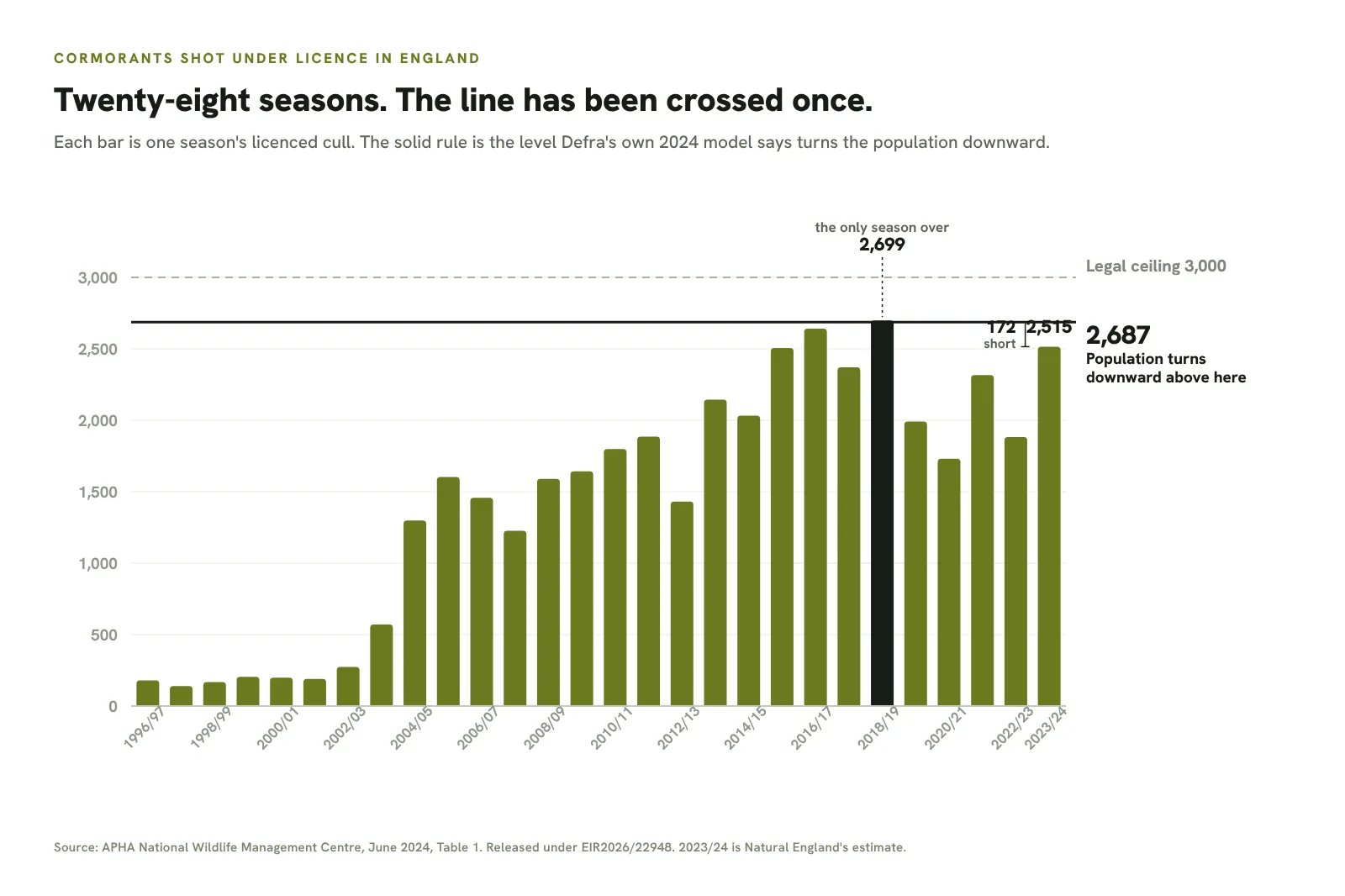
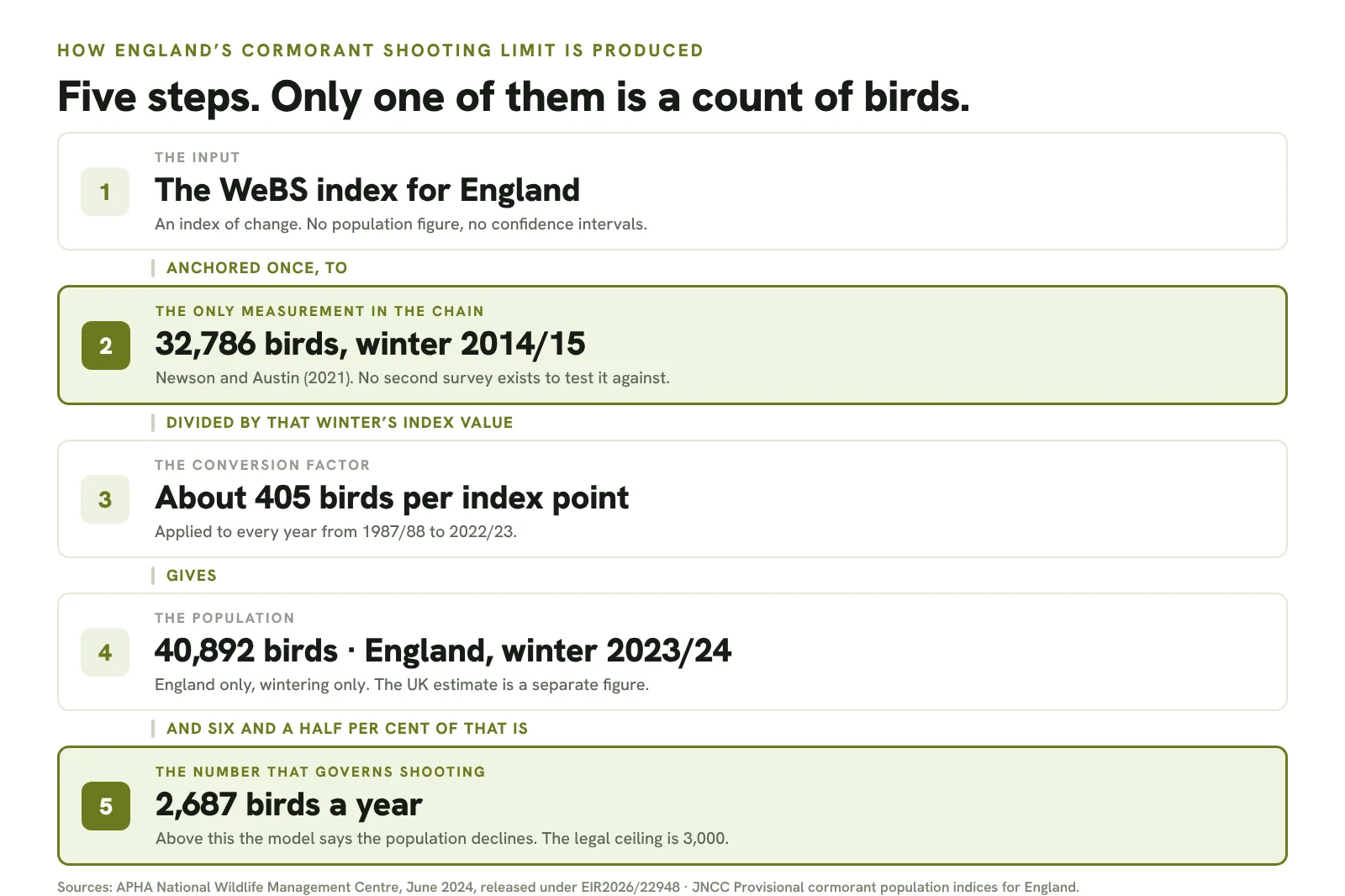
The June 2024 report models the English wintering population at 40,892 birds, growing at a mean 6.6 per cent a year, and states a threshold directly. When the number of birds shot annually is greater than 2,687, the population will on average decrease.
In 2023/24, the most recent season in its figures, 2,515 were shot under licence.
That 2,515 is Natural England's own estimate rather than a final count. Returns for that season were still coming in when the modelling was done, and no later figure has been published. It is the most recent number the department has, and the margin it leaves is small enough that it ought to be confirmed before anyone leans on it. Everything below holds whatever the final figure turns out to be.
The ceiling was never the constraint
The highest number of cormorants ever shot under licence in England in a single year is 2,699, in 2018/19. In 2022/23 it was 1,882.
The ceiling is 3,000 and the best season on record came in 301 birds short of it. The threshold is 2,687, and that has been crossed once in twenty-eight seasons of licenced shooting, by twelve birds, in a single year.
The work was dropped because the model kept finding that 3,000 removals would not harm the population. Three thousand has never happened. The department stopped paying to model a number the sector has never reached.
Natural England made the same observation while the model was being specified.
“The current policy is 2000 with scope to go up to 3000 for short periods. Also, the number killed hasn't exceeded 2700 to date, so it would be good to have predictions for the effects of sustained killing at levels below 3000. We don't know if that is sustainable.”
Natural England to APHA, 7 May 2024Natural England asked for predictions at levels below 3,000, which is the range actually licenced. The ceiling has never been tested, and neither has anything underneath it. The regulator does not know whether the level it permits every year is sustainable, because nobody has modelled it.
And the same email establishes something the sector has not generally understood. The working policy is not 3,000 at all. It is 2,000, with scope to go higher for short periods.
Two thousand is below 2,687. A baseline set at 2,000 does not restrain cormorant population growth. It permits it.
The threshold is 2,687. The ceiling is 3,000. The working baseline is 2,000. Only one of those three numbers has ever been defended in public.
The number the whole thing rests on
Which brings us to 40,892, and that figure deserves more scrutiny than it has ever had, because everything downstream moves when it moves.
The Joint Nature Conservation Committee publishes an annual cormorant index for England from the Wetland Bird Survey, as an official statistic. It is an index of change. It carries no population figure and no confidence intervals, and it is released early each year, in the publication's own words, “to enable their use for operational purposes before the main WeBS Official Statistics release”.
The conversion from that index to a number of birds happens exactly once. APHA took a single published estimate, Newson and Austin's figure of 32,786 birds for the winter of 2014/15, divided it by that winter's index value, and arrived at roughly 405 birds per index point. That ratio was then applied to every year from 1987/88 to 2022/23.
One survey. One winter. Twelve years ago. Multiplied out across thirty-six years, with no second survey anywhere in the series to check it against, and nothing in the model allowing for survey coverage or for that ratio drifting across three and a half decades.
Set it beside the official national figure. The Avian Population Estimates Panel, which produces the United Kingdom's bird population estimates, gives wintering cormorant as 64,500 or more for the UK and 62,000 or more for Great Britain, covering 2012/13 to 2016/17. The plus sign is formal notation. It means the true number is likely higher than the one printed, and that no better estimate is available.
That figure does not contradict Defra's. England is part of Great Britain and not all of it, and the periods differ. What it does establish is that the official estimate for the country as a whole is a decade old and carries a published marker conceding it is probably too low. Anyone quoting 40,892 as the number of cormorants in Britain is quoting the wrong number for the wrong country.
And then there is the one occasion anybody went and counted.
In the winter of 2020/21 Natural Resources Wales censused cormorant in Wales directly. Ten principal salmonid rivers walked, 92 per cent of 2,482 kilometres covered, complete counts of 72 stillwaters. The census put Wales at 2,894 birds. The extrapolated estimate for the same country was 5,332 to 5,642.
The two methods disagreed by roughly a factor of two, on the same country, in the same decade, and nobody has resolved it since.
Before anyone reaches for that as proof the birds are over-counted, read how it was done. More than half the Welsh census total, the 1,503 attributed to estuaries, was not counted at all. It was modelled from historic WeBS data, because volunteer surveys were suspended for most of that winter. The raw observed count across the whole of Wales was 564 birds. Stillwaters were counted at noon, with dusk counts only where possible, and only waters of a hectare or more were included. The report states in terms that its raw observations “should be considered an underestimate of the population”.
One hundred and eighty four cormorants across the stillwaters of Wales, counted at midday, on waters of a hectare or more. Any fishery manager in the country can tell you what that figure is worth.
The honest position is not that the population is larger than Defra says. It is that nobody knows, and that the gap between the two methods anyone has attempted is wide enough to swallow the entire question. One of them rests on a single twelve-year-old survey, the other on a census half of which was modelled rather than counted, and the official national estimate above both of them carries a published flag conceding it is too low.
We asked Defra, in terms, what it holds on the reliability and limitations of these figures. It released two documents. Neither addresses them.
Either way
The threshold moves with the population. 2,687 is not a fixed quantity. It falls out of the model as a fraction of the standing population, a little under the 6.6 per cent annual growth the model fits, which means every question about the population figure is also a question about the threshold.
Which leaves two possibilities, and angling wins both.
If 40,892 is right, the threshold is 2,687, we have never reached it, the ceiling above it has never been spent, and the constraint on cormorant management in England is not the law. It is us.
If the population is larger than 40,892, the threshold sits above 2,687, and a ceiling of 3,000 against a working baseline of 2,000 cannot be defended on Defra's own method.
What cannot be true is the position as it stands: a baseline below the threshold on the department's own figures, justified by reference to modelling the department stopped paying for.
What they actually refused
The 2020 decision not to add cormorant to the general licence is usually read as a finding that cormorants do not cause serious damage. It is not. Defra's own assessment, quoted in the chain, concedes the damage limb in terms.
“Regarding serious damage to fisheries and inland waters, there is evidence to conclude a need, and that this need is widespread coupled with an overall increasing cormorant population. However, we have a significant concern that under a general licence the current holistic approach ... would be eroded, and significantly more birds would be shot to reduce local population densities, rather than to reinforce other scaring techniques.”
Defra general licence review, 2020, quoted in the disclosed chainThat is a concern about losing the audit, not about the damage. The department cannot see what happens on the bank, so it will not hand over an instrument it cannot watch.
It is the most reasonable thing in the whole disclosure, and the only part of it that is fixable from our side.
The thing worth asking for
A licence conditioned on reporting answers the objection on its own terms. Register the water and name the operator before anything happens. Log every non-lethal deterrent action with date, time, method, birds present on arrival and whether it worked. Log every sighting with date, time, count, behaviour and position. Return every bird shot, with subspecies where it can be determined, and return nil where nothing was shot. Give the regulator read access to all of it as it happens rather than a form in the post after the season closes.
That is not a weaker instrument than the one we have. It is a considerably stronger one. Under the current regime Natural England receives a paper return weeks or months after the event and has no view of the deterrent effort at all. Under a reporting condition it would hold the deterrent record, the sighting record and the cull record for every water in the country, live, and could suspend any licence the moment a return went missing.
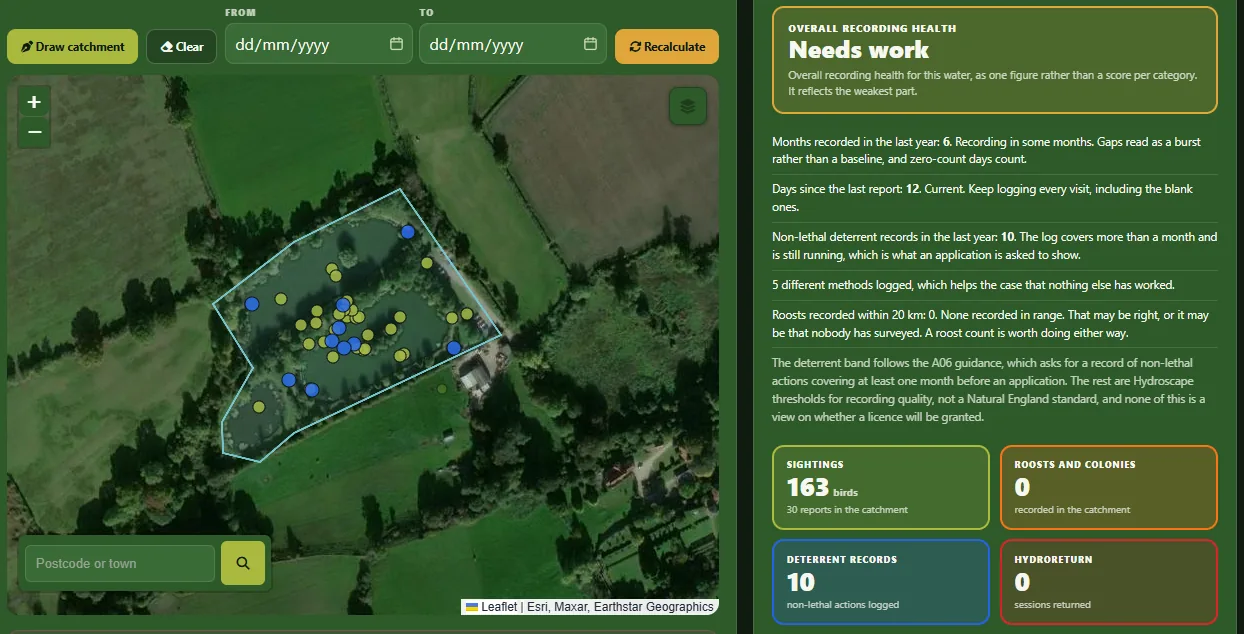
We have a commercial interest in saying so and it should be stated. We developed the Hydroscape platform and it already does this work for the fisheries that use it. Discount the recommendation accordingly. The argument does not depend on who makes it.
And the fish
One limb of the 2020 assessment failed outright, and it is the one that matters most in the long run. On conservation of wild fish stocks, Defra found that it did “not have evidence that cormorant predation is causing a conservation impact on wild fish assemblages”, and so could not conclude there was a genuine need.
That is a gap in the evidence, not a finding of no effect, and it is a gap anglers can close. It needs counted fish on waters where cormorant pressure is also counted. On most coarse fisheries the fish are not counted, which is why the argument has never been winnable there. On the salmon rivers they are.
Nobody at Defra is waiting for our feelings about this. One of its own officials spent March 2024 worrying about whether the department was “subconsciously treating species differently because of historic attitudes”, comparing cormorant to rook, which sits on the general licence already. They are capable of asking the right questions. What they do not have is the data to answer them.
Shortly
The petition running now is number 771307, and it does not ask for a bigger licence. It asks for fish-eating birds to be added to Schedule 2.1 of the Wildlife and Countryside Act 1981. It has passed fifteen thousand signatures and is open until 26 December.
Defra answered it on 27 July 2026. The answer says the consultation on Schedule 2.1 has already happened, that proposals to add cormorant, goosander and red-breasted merganser were received, that they are being considered alongside other suggestions, and that final decisions will be taken by Ministers and “published shortly”.
On 30 October 2026, answering our request, Defra confirmed that it holds no terms of reference for the review of Part 1 of Schedule 2, and that the review has not concluded, so no final report exists.
Three months separate those two statements. A review with no terms of reference has no scope anyone can hold it to and no date by which it has to finish, which makes shortly a word rather than a commitment.
What this changes
Not the target. There are 485 birds of headroom beneath the existing ceiling, and only 172 of them have to be claimed for the population to turn over on Defra's own arithmetic. Both numbers are available this winter, under the law exactly as it stands, with no consultation, no ministerial decision and no change to any licence. They are available to any fishery that logs its sightings, logs its deterrent action and applies.
What changes is the ground the argument is fought on. For twenty years we have asked for a bigger number while leaving the number we had unspent, and every refusal has said so. We can stop guessing now. Defra's own model says where the line is. Its own figures say we have never crossed it. Its own regulator says it does not know what would happen if we did. And its own file says the analysis behind all three was switched off for three years because it kept giving the wrong answer.
They can have the evidence. Every sighting, every deterrent action, every bird, logged and auditable, on any water that will do the work.
What they cannot have is another twenty years of setting the number in private.
The 172 are there now.
No consultation, no ministerial decision, no change to any licence. Every sighting and every deterrent action logged on your water counts towards the national figure, and towards your own application.
Hydroscape is a freshwater biodiversity monitoring platform built by passionate fishery managers with decades of hands-on experience in water management, biodiversity, habitat improvement, and freshwater ecology. Individual reporting forms are free, no account required. Licence application support for fisheries is provided at no cost.
hydroscape-group.co.uk · info@hydroscape-group.co.uk
Sources
Every quotation in this piece is reproduced verbatim from documents released by Defra under the Environmental Information Regulations 2004. Personal data was withheld by the Department, so no individual officials are named.