There's a thing anglers say, half-joking, when a familiar argument comes around again. "We've done this before and filled in bloody forms and nothing's changed." Then someone older says they've been doing it for ten years. Then someone older still says they were doing it in the 1990s, when the cormorants first arrived in numbers on inland waters and the licencing question first got asked.
That's not a joke any more. That's a description of how the system actually works.
The cormorant conversation in this country has been stuck on the same loop since the early 1990s. Same questions, same answers, same outcomes. Anglers report what they see. Fishery managers apply for licences. The licences come back limited, conditional, slow. Representative bodies lobby for change. Government convenes another review. The review concludes more evidence is needed. Another season passes. Another year-class disappears. We start again.
Einstein supposedly said the definition of madness is doing the same thing over and over and expecting a different result. Whether or not he actually said it, it's a fair description of where we are. So this piece is about why we keep getting the same result, and what changes now.
Not "what should change," in that abstract way articles like this usually finish. What changes. What's already changing. What anglers can do this week that wasn't possible last year.
Because we keep going round the loop and the answer keeps coming back the same. More evidence needed. And we, as anglers, still haven't given it to them. Your complaints don't count as evidence.
Where we are
Let's set the scene with primary sources, because if you read most of what's written about cormorants and angling, primary sources are exactly what's missing.
Cormorants were removed from the general shooting licence in 1981, under the Wildlife and Countryside Act. That's the trigger event. Before 1981, a fishery manager could shoot a cormorant on their water without paperwork. After 1981, every bird taken needed an individual licence from what is now Natural England.
In 1991, four cormorant control licences were issued in England. By 1994, that had risen to twenty-four. Both figures are on the Hansard record (House of Lords debate, November 1994). Inland cormorant populations were rising fast. The Angling Trust's figures show roughly 2,000 over-wintering inland cormorants in the early 1980s, rising to a current figure of over 62,000. The Joint Nature Conservation Committee's official statistics show a 66% increase in the English population over the last 25 years.
The licencing system has been "adjusted" repeatedly over those three decades. The 2011 Defra review. The 2014 class licence consultation. The 2019 General Licence review. The 2020 rejection of cormorants on the General Licence. The current A06 individual-application scheme, with its national cap of 3,000 birds a year and its September-to-April licensable window. The last meaningful change to how the licencing system actually works for fisheries was in 2014. Everything since has been a reshuffle of the same scheme, driven mostly by court challenges that had nothing to do with anglers. Twelve years of consultations and reviews. No meaningful change in what a fishery manager can do about cormorants on their water.
Worth understanding how the cap actually gets set. In January 2008, Natural England published the threshold decision for that licencing year. The previous year they'd licenced 2,178 birds. Of those, 1,458 had been reported shot. About a third unused. Natural England's response was to reduce the cap by nearly 400 birds, citing model projections about population stability. The document acknowledged the under-shoot openly. Between 63% and 72% of licenced birds had been reported shot in every year from 2004 onwards. It never asked why the gap existed. The cap kept being treated as the lever. The reasons fisheries weren't taking the birds they were licenced for never entered the conversation. The threshold-setting logic hasn't materially changed since.
The reason is simple, and it's the reason this article exists. The licencing system runs on evidence. The kind of evidence it accepts has to be documented, time-stamped, place-specific, attributable, repeatable. Anglers and fishery managers possess, by some distance, the largest body of observational evidence about cormorant behaviour on UK freshwaters in existence. Almost none of that evidence is in a form the licencing system can use.
That's the gap. That's the loop.
Why nothing moves
There are three places the cormorant conversation gets stuck. They look different. They're the same problem.
The licencing cycle. A club applies for an A06 individual licence. The application needs evidence: records of non-lethal measures tried, evidence of damage occurring or likely to occur. The fishery manager pulls together what they can. A folder of scarer receipts, some bailiff notebooks, a few photos, recollections from members. The application goes in. Natural England assess it against five published tests. The licence comes back limited, sometimes refused outright, often with a request for more evidence. The cycle resets. Next year, the same fishery, the same manager, the same shoebox. The reason isn't that the case is weak. It's that the evidence base is fragmented, informal, and never written down somewhere that survives the season.
The representation cycle. Existing channels lobby on behalf of angling. They commission reports. They meet ministers. They submit consultation responses. They publish briefings. The reports are good. The reports are detailed. The reports are written, in most cases, by people who know the subject and have spent years on it. The reports get filed alongside other reports and the conversation continues. The problem isn't that angling lacks people who will speak up. The problem is that what the system asks for, when push comes to shove, isn't a position paper. It's data. Numbers. Patterns. Time series. The kind of thing that only emerges when thousands of people are recording what they see, in the same format, in the same place, over years. Existing channels aren't built to produce that. They're built to argue from it, once it exists. It doesn't exist yet.
The cultural cycle. Anglers see cormorants daily and watch them empty water. They know what's happening. They tell each other. Conservation bodies see population indices and a species recovering from a long history of persecution, with a recent levelling off. They know what they're seeing too. Both groups, in their respective conversations, are right about what they're looking at. Neither group has the data to argue across the gap. So the cultural conversation defaults to its known positions. Anglers are accused of wanting to blame everything on cormorants. Conservation bodies are accused of refusing to admit any problem exists. Nobody moves. The press doesn't move it. The minister doesn't move it. Another season passes.
Three cycles. One underlying problem. The evidence anglers have is real, it's substantial, it's accurate, and it's currently sitting in 50,000 different heads, notebooks, phone galleries, club minutes, and WhatsApp groups, where it can't do any work.
That's the thing that changes.
What changes now
There are some things in angling that no individual angler can fix. You can't, by yourself, change the regulatory framework. You can't, by yourself, conduct a national population survey. You can't, by yourself, build a case strong enough to shift a Defra position that's been held for fifteen years.
But there's something every angler can do, that until very recently was technically impossible at scale, and that, done by enough people, fixes the underlying problem the other three cycles are stuck on.
Record what you see. In a format that compounds. In a place that survives.
That's it. That's the change.
Not because recording sightings is glamorous, or because filling in a form on your phone feels like activism. It doesn't. But because the licencing system, the representation system, and the cultural argument all converge on the same demand, which is: show us the data. And the data, as of now, doesn't exist in any form that can answer that demand at scale. Once it does, all three cycles look different.
A licence application backed by twelve months of GPS-stamped, photo-verified sightings from a single water (flock sizes, behaviours, daily patterns, deterrents tried and dated, response observed) is a different application from the shoebox of scarer receipts. It's the application the system has been asking for. Most clubs have never been able to produce it because the underlying records weren't there. Now they can be.
A representation body arguing for policy change with a dataset of half a million cormorant records across the country, with seasonal patterns, regional variation, deterrent effectiveness data, and impact correlation against fish stock records, is arguing from a different place than one quoting Avon Roach Project numbers from 2011. It's arguing from now. From data that updates daily. From a national picture that emerges from individual contributions.
A cultural conversation in which the angling side can point to evidence and the conservation side can engage with that evidence, instead of both sides talking past each other from their respective positions, is a conversation that can actually move. JNCC say the population's levelled off, and that's an honest reading of the data they have. The data anglers have, currently fragmented across the country, would tell a different story about impact at site level even if the national index is flat. Both readings can be true. Until somebody puts them next to each other, nobody knows.
The single largest body of observational data about cormorants on UK freshwaters is currently sitting unused, in the heads and notebooks of the people who fish those waters. Coordinated, time-stamped, place-specific, photo-verified, it becomes something the licencing system can't ignore, the representation channels can argue from, and the cultural conversation has to engage with.
That's not a hope. That's how every other environmental data shift in the last twenty years has actually happened. Birds, butterflies, water quality. None of those areas moved from anecdote to evidence because the government commissioned a study. They moved because thousands of people started recording what they saw, in the same format, in the same place, over years. The data accumulated. The arguments shifted. The policy followed.
The cormorant question is exactly the same shape. There's no good reason it should be the one wildlife question in the UK still stuck in 1995.
What we're building
We started Hydroscape because we came at this problem from the fisheries first. Passionate fishery managers with decades of hands-on experience in water management, biodiversity, habitat improvement, and freshwater ecology. People who'd watched the same loop run on water after water, with no shared way to capture or act on what anyone was learning. We built the platform we wished had existed twenty years ago.
You can use it without us telling you anything else about it, and most of what matters is free.
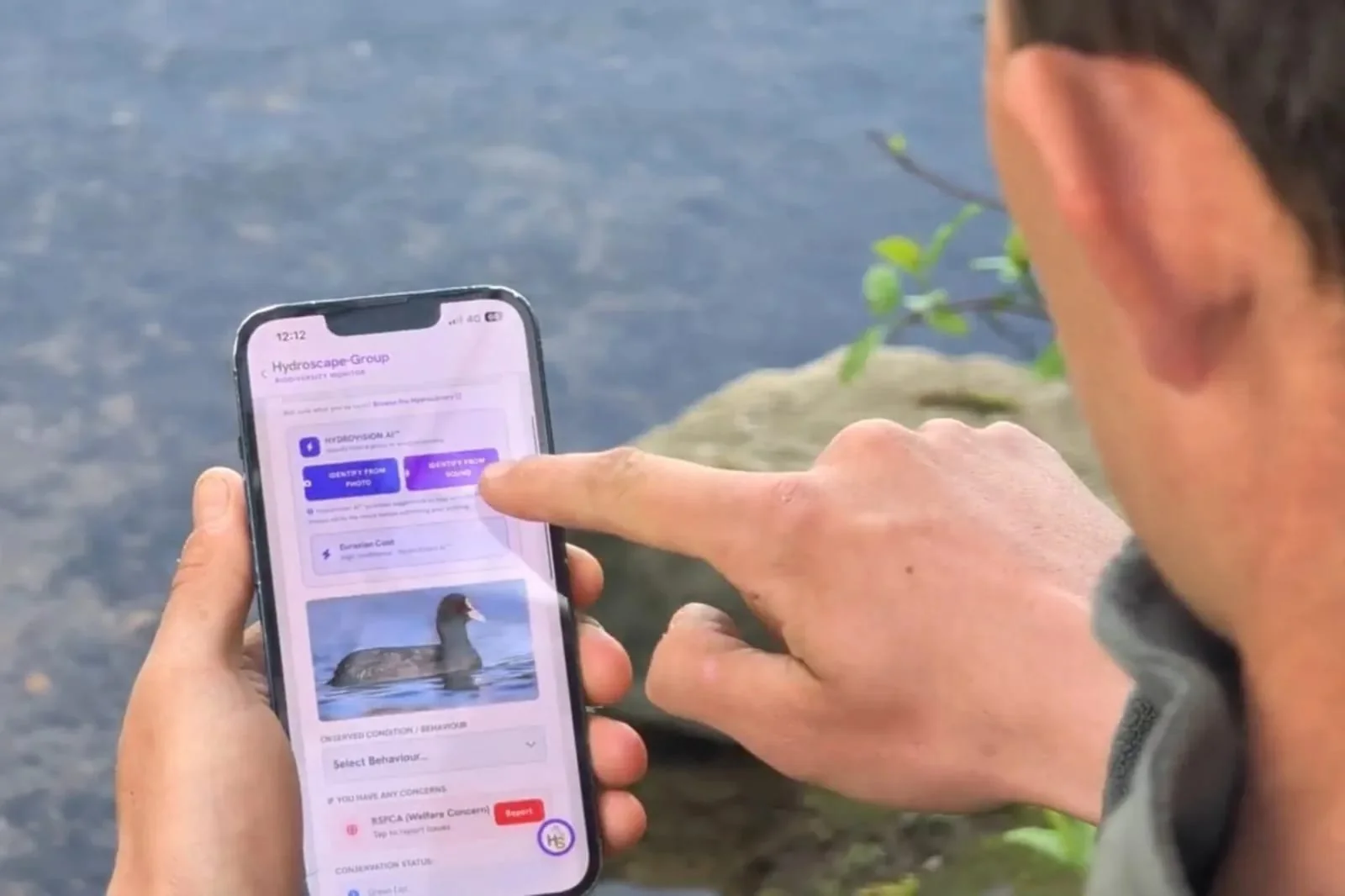
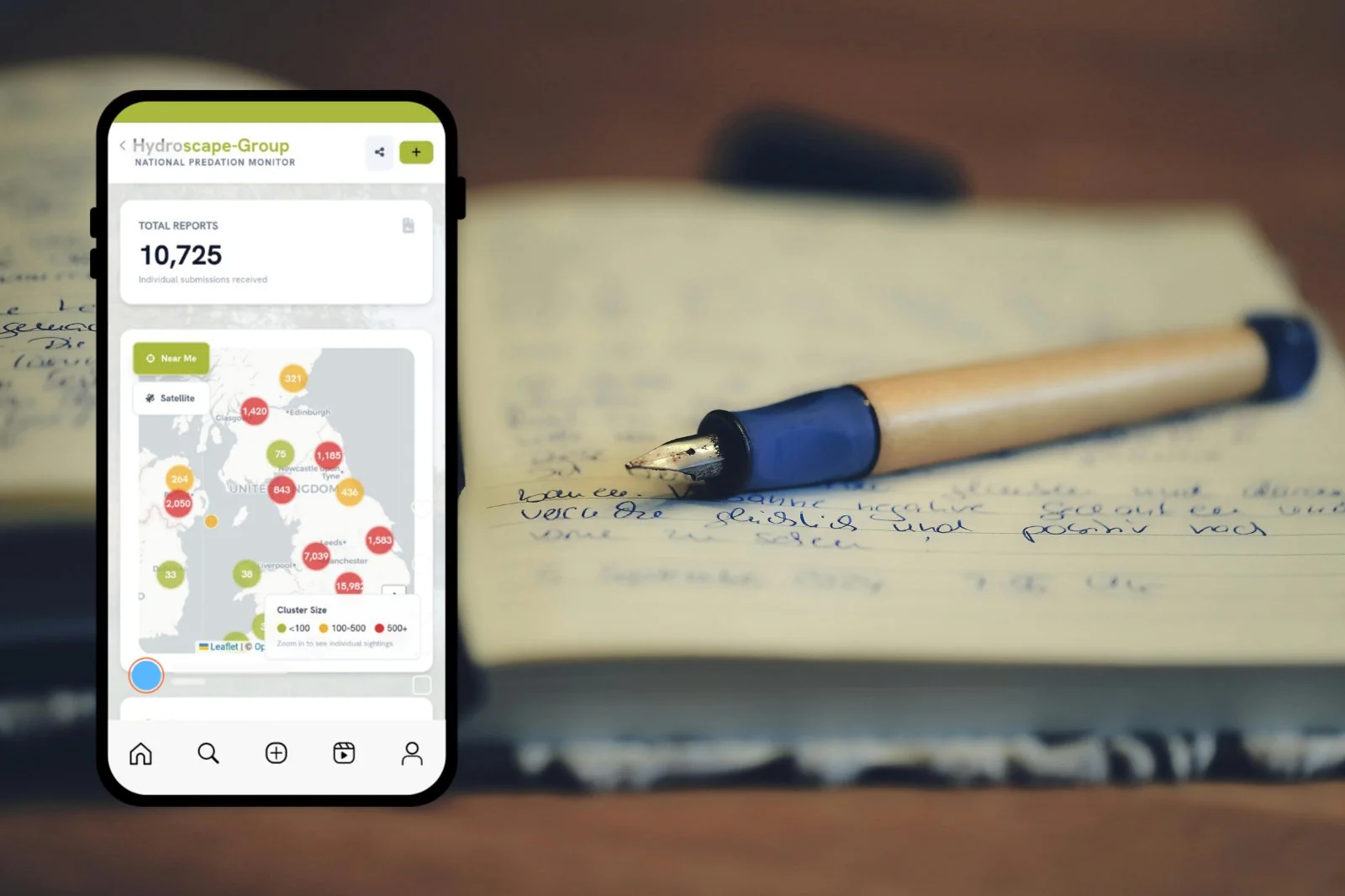
On your phone, at the bankside, you log what you see. A cormorant. A flock. A roost. A deterrent deployment. A kill. A predation sign. GPS-stamped, time-stamped, photo-verified by an AI species check. Half a minute per record. The public reporting forms work without an account. A free MyHydroscape account gives you a personal dashboard, a record of your contributions over time, badges as you build up data, and a personal biodiversity report you can export.
For clubs and fishery managers, there's a dedicated cormorant module called HydroDeter, and an A06 builder that formats your data into the structure Natural England's application actually asks for. Sightings, deterrent trials, roost surveys, non-lethal measures dated and described. The same data your bailiffs and members are already collecting, captured in a form the system has to take seriously.
For everyone, the data flows into a national picture. Not owned by us. Open. Visible on the live data map. Available for anyone to query, anyone to cite, anyone to build on. The point isn't that Hydroscape becomes the holder of the evidence. The point is that the evidence finally exists somewhere where it can be argued from.
That's the platform. That's what's already running. That's the answer to "what does an individual angler do."
You log what you see. You log it where it compounds. The compounded data does the work that thirty years of position papers and consultations haven't been able to do, because it answers the one question those papers and consultations keep getting stuck on: show us the numbers.
Starting this week
The cormorant conversation has been stuck for thirty years because the evidence anglers have hasn't been gathered. It hasn't been gathered because, until recently, there was no practical way to gather it. There is now. The cost to any individual angler is half a minute per sighting. The benefit, at scale, is the first real shift in the underlying dispute since the 1990s.
If you fish a water that holds cormorants, log what you see this week. If you manage a fishery, get your bailiffs and members logging. If you sit on a club committee, take five minutes at the next meeting to put the platform in front of members. If you're at a club where someone has already started, ask them how it's going. If you're not sure where to start, the cormorant sighting form is at hydroscape-group.co.uk and you don't need to sign up to use it.
Thirty years of doing the same thing and getting the same result. We can keep doing that. The other option is that anglers, who already have the data in their heads, put it somewhere it can do some work. That's the option we'd recommend.
Same conversation, different ending. Starting now.
The Hydroscape Team
Two ways to start.
Log a cormorant sighting from your phone. Or talk to us about your club.
Hydroscape is a freshwater biodiversity monitoring platform built by passionate fishery managers with decades of hands-on experience in water management, biodiversity, habitat improvement, and freshwater ecology. The cormorant funnel, from sighting submission to non-lethal deterrent logging to A06 evidence pack generation, is end-to-end free for fisheries.
hydroscape-group.co.uk · info@hydroscape-group.co.uk