Two subspecies of Great Cormorant use British waters, and one character tells them apart. It isn't size, and it isn't plumage.
The nominate form, Phalacrocorax carbo carbo, has bred on our coast for centuries. The continental form, P. c. sinensis, started its first inland colony at Abberton Reservoir in Essex in 1981 and has spread across inland waters since.
Knowing which is on your water is worth having. Natural England looks at the population context around a site when it assesses an A06 application, and the two subspecies sit in different population pictures.
The shape of the gular pouch, the bare yellow-orange skin at the base of the lower mandible, is the only reliable field character. Measure the angle between the gape line and the rear edge of that patch, with the bird in full profile and its bill roughly level.
Below 65 degrees, the rear edge slopes back towards the bill tip and the patch comes to a point. That is carbo. Above 73 degrees, the rear edge drops near-vertically and the patch is square. That is sinensis. Between 66 and 72 degrees, about one bird in ten, it can't be called either way.
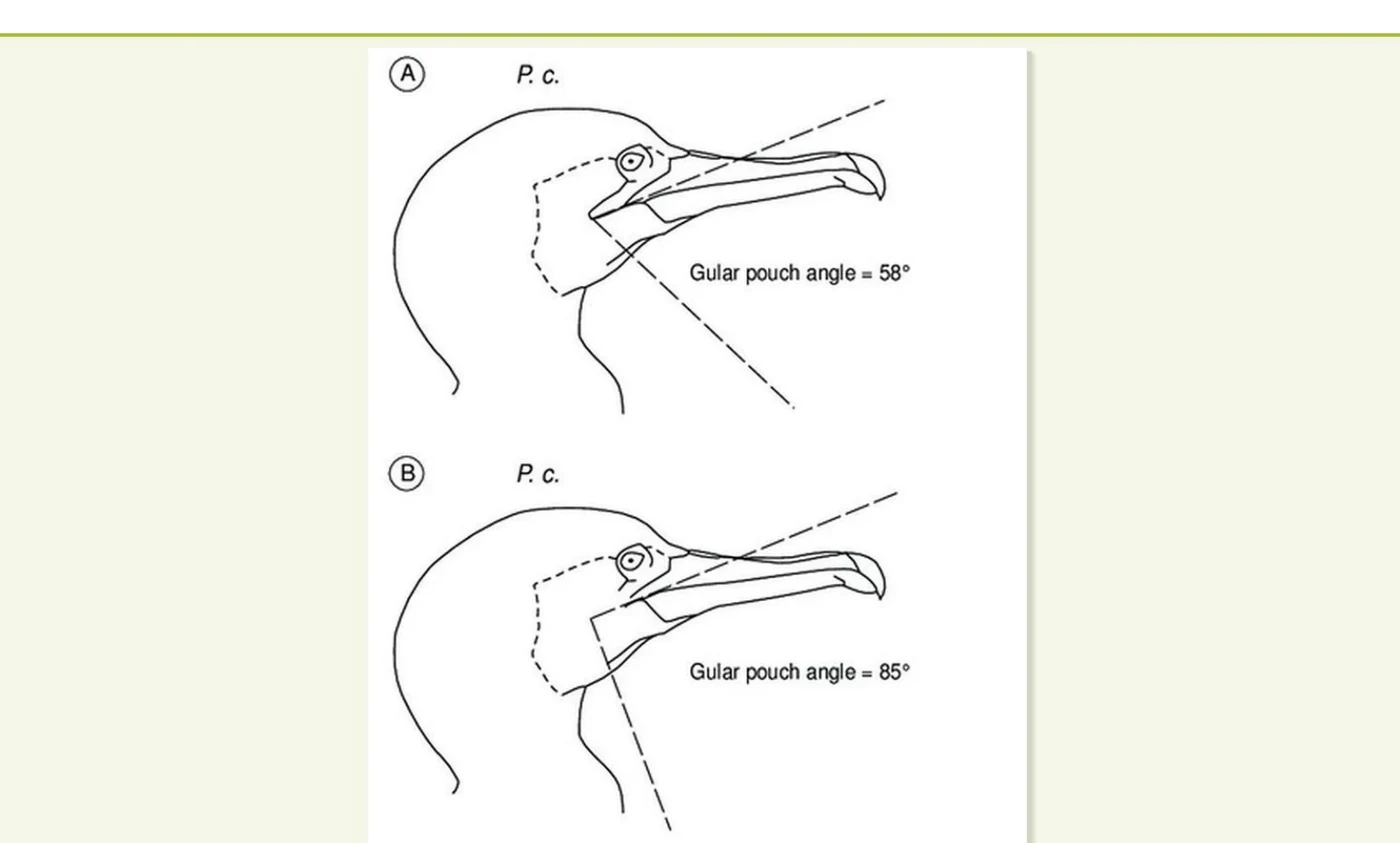
| Measurement | P. c. carbo | P. c. sinensis |
|---|---|---|
| Gular pouch angle | Under 65°, an acute angle | Over 73°, an obtuse angle |
| What you see | Rear edge slopes back towards the bill tip. Pointed patch. | Rear edge drops vertically from the gape. Square patch. |
| Full range | 38° in Greenland to 72° | 66° to 111° in China |
Between 66 and 72 degrees the ranges cross, so a bird in that band can't be called either way. That is about one bird in ten in a mixed colony.
When the angle falls in the overlap zone, or the bird won't give you a clean profile, these help. None of them settles it on its own.
| Character | P. c. carbo | P. c. sinensis |
|---|---|---|
| Bill depth | Deeper, heavier | Shallower, finer |
| Bill length | Longer on average | Shorter on average |
| Build | Heavier, more robust | Lighter. Can look almost Shag-like. |
| Face | More dark on the lores | Cleaner face, often a beady-eyed look |
What doesn't work
Older guides lean on characters that don't hold up. White head plumes in the breeding season vary with age and individual, and overlap heavily. Body size overlaps so far that a large female carbo and a small male sinensis can't be separated by size at all.
Plumage sheen is a trick of the light: both show bronze, green or purple depending on the angle. And nesting habitat no longer tells you anything on its own, because carbo is increasingly found at inland tree colonies, particularly the older established ones.
Until 1981 the Great Cormorant bred almost only on the coast here, and the whole breeding population was carbo. The first inland tree colony went up at Abberton Reservoir that year, founded by continental birds from the Netherlands and Denmark.
It grew fast. By 2005 there were at least 2,096 pairs at 80 inland sites, and by 2012 about 2,362 pairs at 89 sites, with new colonies still going up and the range pushing into south-west England.
A pan-European census in 2006 put the continent at roughly 284,500 breeding pairs: about 52,143 carbo and 232,311 sinensis. Across Europe, sinensis outnumbers carbo by around four and a half to one.
The line is blurring
As the inland colonies established, carbo birds from coastal colonies in Wales and England started joining them. Genetic work at colonies like Abberton has confirmed the two now live side by side and interbreed. The young of those pairs show intermediate angles, in that 66 to 72 degree band, and can't be assigned to either.
The gene flow looks asymmetric, more often from sinensis into carbo than the other way. Over time that has consequences for the genetic identity of the Atlantic bird.
| Season | P. c. carbo | P. c. sinensis |
|---|---|---|
| Spring (Mar to May) | Breeds at coastal cliff colonies. Some now join inland colonies. | Breeds at inland tree colonies. New colonies still forming. |
| Summer (Jun to Aug) | Fledged young disperse along the coast. Moult starts late summer. | Fledged young disperse widely. Post-breeding movement to fisheries. |
| Autumn (Sep to Nov) | Some dispersal from coastal colonies. Winter roosts forming. | Continental birds arrive from the Netherlands, Denmark and the Baltic. Numbers peak. |
| Winter (Dec to Feb) | At coastal roosts. Some move to estuaries. | Maximum numbers at inland fisheries. Migrants on top of resident birds. |
Diet work on more than 1,400 birds at inland fisheries found the subspecies feed differently. The biggest birds, male carbo, take fewer but larger fish. The smallest, female sinensis, take more of them and smaller.
Male carbo are likelier to work a fishery where the larger prey is, a put-and-take trout water for instance. What that means in practice is that the damage looks different depending on what you run.
When to look
Best when birds are loafing at a roost, standing with their heads in profile. Early morning and late afternoon gatherings give you the most chances. Facial skin colour is clearest in the breeding season, March to June.
The quick method, no protractor
Imagine the bird is holding its bill perfectly level. Find the rear edge of the bare facial skin. Drop an imaginary vertical line from the gape, the corner of the mouth.
On sinensis the rear edge drops nearly straight down, giving a square patch. On carbo it slopes back towards the bill tip, giving a pointed one.
What catches people out
Sinensis often hold their bills pointed up, which makes the angle look more acute than it is. Wait for a level bill.
At long range the patch shape is very hard to confirm, so photograph it and look afterwards. Around one bird in ten in a mixed colony is intermediate and can't be called. And juveniles are harder again: the patch is less developed and the facial skin less distinct.
Binoculars at 8x42 or 10x42 will do, or a scope for distant birds. A camera with a zoom is worth more than either, because it lets you settle the angle at home. And patience: birds spend a lot of time preening or asleep with their bills tucked, which hides the patch entirely.
Natural England looks at the population context at and around your site when it assesses an A06 application. Knowing your subspecies composition feeds that in three ways.
It tells you which population picture applies. The sinensis population has grown enormously and isn't conservation-limited the way some carbo populations are.
It shows where the winter pressure comes from. Continental birds arriving each autumn sit on top of the resident population, and documenting that influx shows how much of your problem is non-resident.
And it sharpens the damage argument, because the two feed differently. Fewer larger fish at a trout water, higher volumes of smaller fish at a coarse one.
Every sighting you submit through the Hydroscape App carries a GPS position and a timestamp, which is what makes seasonal analysis possible: resident birds against autumn arrivals. Photographs go through Hydro-Vision AI for species verification and count accuracy, and subspecies indicators visible in a photograph get flagged.
Hydro-Vericount produces a defensible Minimum Confirmed Population across a 5km radius, and the A06 Licence Builder pulls your sighting records, deterrent logs and financial impact into a structured application. All of it free for fisheries.
Grøndahl and Johnsen (2024), Combining biometrics and genetics to distinguish two subspecies of the Great Cormorant. Ornis Norvegica 47, 25 to 40. Gular pouch angles, the overlap zone, and the direction of gene flow. The diagram above is from this paper.
Newson et al. (2004, 2005), Sub-specific differentiation and distribution of Great Cormorants in Europe. Ardea 93. Subspecies separation and European distribution.
Newson, Marchant, Ekins and Sellers (2007), The status of inland-breeding Great Cormorants in England. British Birds 100, 289 to 305. Inland colony counts, 1981 onward.
Van Eerden and Gregersen (1995), Long-term changes in the northwest European population of Cormorants. Ardea 83, 61 to 80.
Winney et al. (2001), The subspecific origin of the inland breeding colonies of the cormorant in Britain. Heredity 86, 45 to 53. DNA confirmation that the inland colonies hold both races.
BTO, Cormorant species account. Population trends and breeding distribution.
Natural England, Definition of Favourable Conservation Status for Great Cormorant. How the races are treated separately, and the licencing thresholds.
Ken Billington / Wikimedia Commons. Cormorant photography, CC BY-SA 3.0.
Record what's on your water
Log a sighting with a photograph and we'll verify the species and the count. The subspecies indicators get flagged where the picture shows them.
Report a Cormorant Sighting Get Licence SupportThe Hydroscape Team